Radical Technologies
CLOUD COMPUTING - AWS
★★★★★
(2,095 ratings)  50,000+ Student

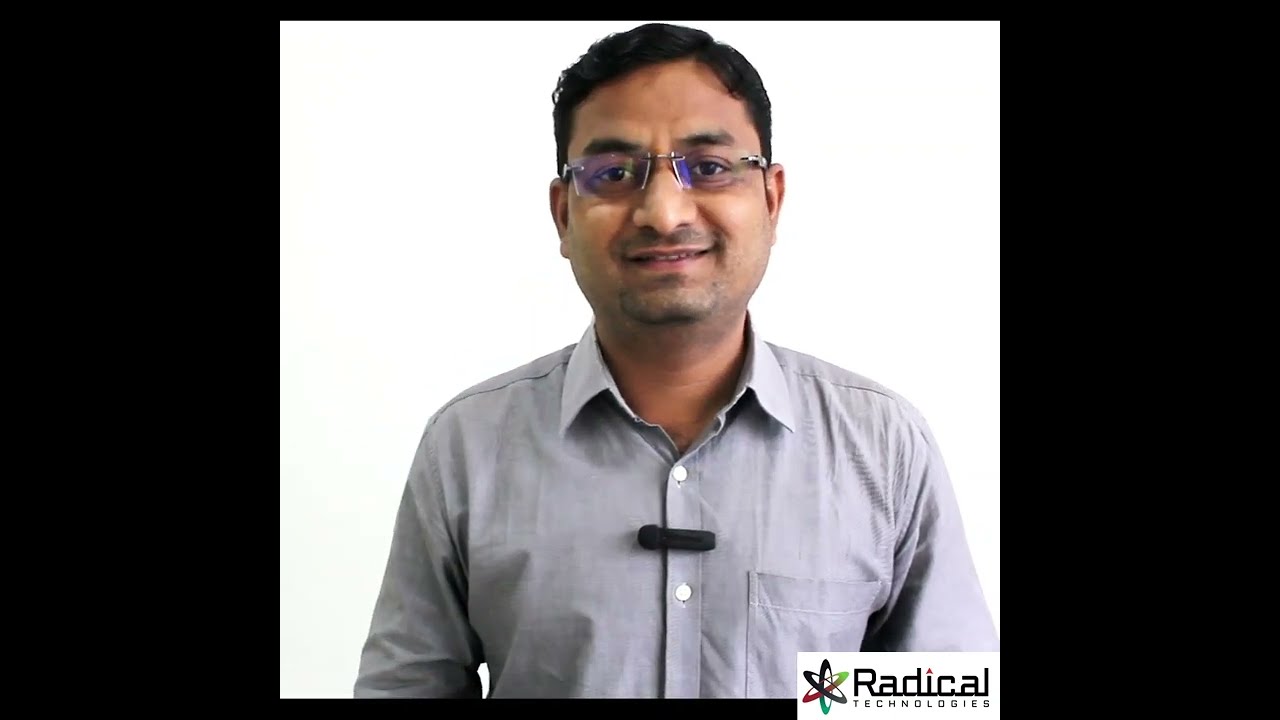
INDUSTRY AWS CERTIFIED SOLUTIONS ARCHITECT – ( Anand sir)

AWS Cloud Industry Training By Anand Tiwari. – Offline @ Aundh Pune 1] Designing and deploying scalable, highly available, and fault tolerant systems on AWS 2] Lift and shift of an existing on-premises application to AWS 3] Ingress and egress of data to and from AWS 4] Selecting the appropriate AWS service based on data, compute, database, or security requirements 5] Identifying appropriate use of AWS architectural best practices 6] Estimating AWS costs and identifying cost control mechanism

RT
Radical Technologies
50,000+ English 60 hours Weekdays / Weekends Classroom / Online / Corporate
Online / Classroom

INDUSTRY AWS CERTIFIED SOLUTIONS ARCHITECT – ( Anand sir)

IT Training Programme

Duration 60 hours
Batch Type Weekdays / Weekends
Mode of Training Classroom / Online / Corporate
Locations Pune, Bangalore, Kochi
Language English
Certification Globally Recognized
Call Now

100% placement assistance

What you'll learn

Understand core concepts and architecture from the ground up
Get hands-on with the tools used by working professionals
Build real-world projects you can add to your portfolio
Learn industry best practices and coding standards
Practice with real datasets and real-world scenarios
Prepare for certification and technical interviews
Work on collaborative, team-based exercises
Apply performance tuning and optimization techniques
Understand how the technology fits into a larger ecosystem
Complete assignments reviewed by mentors

Programme Overview

9 sections covering the complete curriculum — a single, progressive learning arc.

60 hours
Training Duration
9
Core Modules
388
Total Lessons
4.4
Average Rating
50K+
Students Trained
01

Foundations & Core Concepts

Get hands-on with the fundamentals and architecture — the building blocks for everything that follows.

Fundamentals Architecture Setup
02

Hands-On Practical Training

Work through real exercises and assignments designed to mirror what you will do on the job.

Practicals Assignments Labs
03

Real-World Projects

Apply what you have learned to end-to-end projects that go straight into your portfolio.

Projects Portfolio Case Studies
04

Advanced Techniques

Go beyond the basics with advanced concepts, integrations and production-grade practices.

Advanced Integration Best Practices
05

Ecosystem Integration

Understand how this technology connects with the broader tools and platforms used in the industry.

Ecosystem Tools Platforms
06

Performance & Interview Prep

Master optimization techniques and prepare for the technical interview questions employers actually ask.

Optimization Interview Prep Certification

Who is this programme for?

Whether you're already writing code, working with data, or supporting applications today — this programme is built to take you into a CLOUD COMPUTING - AWS role.

Software Developers

Engineers who want to add this skill set to their toolkit

Analysts & Consultants

Professionals moving into a more technical, hands-on role

IT Professionals

System admins and support engineers upskilling into a new domain

Fresh Graduates

CS/IT graduates aiming for a job-ready technical role

Course Curriculum

9 sections  •  388 lessons  •  60 hours

01 AWS Certifications Available
AWS Solutions Architect ==> AWS Sysops Administration ==> AWS DevOps Engineer
AWS certification training in pune
AWS Live Projects
AWS POC’s
AWS Multiple Assignments
Cover All contents of AWS Solution Architect Exam
Live Migration from VMware vsphere to AWS
Live Migration from Azure to AWS
AWS VPC, EC2, VPN Gateway
VPN connectivity from Azure to AWS
Interview and CV Preparation.
AWS Mock interviews.
02 What You Get
 
Advance storage DAS/SAN/NAS/Object design and implementation
Advance L3 level Networking and Network trouble shooting with end to end VPC design
Advance Security with VPN implementation and 4 type of firewalls
Complete database with real time RDS fail over design
Production grade 3 tier Architecture design on LAMP stack
Multiple real time Projects
100 plus scenario based practical
100% practical Hands training
One can claim 2yr L2 level experience in CV after completing this class
******************************************
Note : Each AWS lecture will be followed by a hands-on demo/activity wherever applicable
03 AWS COURSE CONTENT

Getting Started :

Course Introduction
About the Training Architect
Working as a Solutions Architect
Creating an AWS Account, AWS Free Tier, Usage Tracking, and Billing Widget
Access Management
Shared Responsibility/Security Model
Service Models
High Availability vs. Fault Tolerance
RPO vs. RTO
Scaling
Tiered Application Design
Encryption
Architecture Odds and Ends
Architecture 101

AWS Architecture :

AWS Accounts
AWS Physical and Networking Layer
Well-Architected Framework
Elasticity
AWS Architecture 101

AWS Product Fundamentals :

Console Tour and Navigation
Introduction to S3
Introduction to CloudFormation
Hands-on Labs
Getting Started with CloudFormation
AWS Product Fundamentals

IAM (Identity and Access Management) :

IAM Essentials
IAM Policies
IAM Users
IAM Groups
IAM Access Keys
Securing Your Account — Creating an IAM User and Setting Up the CLI
IAM Roles
IAM Essentials

Multi-Account Management and Organizations :

AWS Organizations
Role Switching Between Accounts
Multi-Account Management and Organizations

Server-Based Compute (EC2) Fundamentals :

EC2 Architecture: Part 1
EC2 Architecture: Part 2
Instance Types and Sizes
EC2 Storage Architecture: Part 1
EC2 Storage Architecture: Part 2
EBS Snapshots
Security Groups
Instance Metadata
Hands-on Labs
Creating and Working with an EC2 Instance
Server-Based Compute (EC2) Fundamentals

Server-Based Compute (EC2) Intermediate :

AMI
Bootstrap
Instance ENI, IP, and DNS: Part 1
Instance ENI, IP, and DNS: Part 2
Instance Roles
Server-Based Compute (EC2) Intermediate
Using EC2 Roles and Instance Profiles
Using AWS Tags and Resource Groups

Server-Based Compute (EC2) Advanced :

EBS Volume and Snapshot Encryption
EBS Optimization, Enhanced Networking, and Placement Groups
EC2 Billing Models: Part 1 – Spot and Spot Fleet
EC2 Billing Models: Part 2 – Reserved Instances
Dedicated Hosts
Server-Based Compute (EC2) Advanced

Serverless Compute (Lambda) :

What Are APIs and Microservices?
Serverless and Event-Driven Architectures
Lambda Essentials: Part 1
Lambda Essentials: Part 2
API Gateway Essentials: Part 1
API Gateway Essentials: Part 2
Step Functions
Serverless Compute (Lambda)

Container-Based Compute and Microservices :

Docker Essentials
ECS
Container-Based Compute and Microservices
Networking Fundamentals :
Introduction
Seven-Layer OSI Model: Part 1
Seven-Layer OSI Model: Part 2
IP Addressing Basics
Subnetting
IP Routing
Firewalls
Proxy Servers

Networking Fundamentals

Virtual Private Cloud (VPC) :
Virtual Private Cloud (VPC) and Subnets: Part 1
Virtual Private Cloud (VPC) and Subnets: Part 2
Routing and Internet Gateway
Bastion Host/JumpBox
NAT, NAT Instance, and NAT Gateway: Part 1
NAT, NAT Instance, and NAT Gateway: Part 2
Network ACLs
Hands-on Labs
Designing and Building a Custom VPC from Scratch
Virtual Private Cloud (VPC)

Advanced VPC :

VPC Peering: Part 1
VPC Peering: Part 2
VPC Endpoints: Part 1
VPC Endpoints: Part 2
IPv6 within AWS
Egress-Only Gateway
Hands-on Labs
Implementing VPC Peering on AWS
Advanced VPC

Global DNS (Route 53) Fundamentals :

DNS 101
Domain Registration
Private vs. Public Hosted Zones
Record Set Types
Health Checks
Global DNS (Route 53) Fundamentals

Global DNS (Route 53) Advanced :

Routing Policy: Simple
Routing Policy: Failover
Routing Policy: Weighted
Routing Policy: Latency
Routing Policy: Geolocation
Global DNS (Route 53) Advanced

S3 Architecture and Features :

Permissions
Transferring Data to S3
Encryption
Static Websites and CORS
Object Versioning
Presigned URLs
Hands-on Labs
Creating a Static Website Using Amazon S3

S3 Performance and Resilience :

Storage Tiers/Classes
Lifecycle Policies and Intelligent-Tiering
Cross-Region Replication (CRR)

CloudFront :

CloudFront Architecture: Part 1
CloudFront Architecture: Part 2
OAI

Network File Systems :

EFS Fundamentals: Part 1
EFS Fundamentals: Part 2
Storage and Content Delivery

Database Fundamentals :

Database Models

SQL — RDS :

RDS Essentials: Part 1
RDS Essentials: Part 2
RDS Backups and Restore
RDS Resiliency: Multi-AZ
RDS Read Replicas
Database Fundamentals and SQL — RDS

SQL — Aurora :

Aurora Essentials: Part 1
Aurora Essentials: Part 2
Parallel Queries and Aurora Global
Aurora Serverless Essentials: Part 1
Aurora Serverless Essentials: Part 2
SQL — Aurora

NoSQL :

DynamoDB Essentials: Part 1 — Tables and Items
DynamoDB Essentials: Part 2 — Query and Scan
DynamoDB Essentials: Part 3
DynamoDB Performance and Billing
DynamoDB Streams and Triggers
DynamoDB Indexes: Part 1 — LSI
DynamoDB Indexes: Part 2 — GSI
NoSQL

In-Memory Caching :

DAX
ElastiCache
In-Memory Caching

Load Balancing and Auto Scaling :

Load Balancing Fundamentals
Classic Load Balancers and Health Checks: Part 1
Classic Load Balancers and Health Checks: Part 2
Classic Load Balancers and Health Checks: Part 3
Application Load Balancers: Part 1
Application Load Balancers: Part 2
Network Load Balancers
Launch Templates and Configurations
Auto Scaling Groups: Part 1
Auto Scaling Groups: Part 2
Hands-on Labs
Implementing an Auto Scaling Group and Application Load Balancer in AWS

VPN and Direct Connect :

VPC VPN (IPsec)
Direct Connect Architecture
When to Pick Direct Connect vs. VPN

Snow* :

Snowball, Snowball Edge, and Snowmobile

Data and DB Migration :

Storage Gateway 101
Database Migration Service 101
Identity Federation and SSO :
What Is Identity Federation?
When to Use Identity Federation
Hybrid and Scaling

Application Integration :

Simple Notification Service (SNS)
Simple Queue Service (SQS): Part 1
Simple Queue Service (SQS): Part 2
Elastic Transcoder
Application Integration

Analytics :

Athena
Elastic MapReduce (EMR)
Kinesis and Firehose
Redshift
Analytics

Logging and Monitoring :

CloudWatch
CloudWatch Logs
CloudTrail
VPC Flow Logs
Hands-on Labs
Custom Logging Using CloudWatch and CloudWatch Logs
Hands-on Labs
Working with AWS VPC Flow Logs for Network Monitoring

Logging and Monitoring

Operations :

CloudWatch Events
KMS Essentials: Part 1
KMS Essentials: Part 2

Deployment :

Elastic Beanstalk
OpsWorks
Operations and Deployment

The Exam :

How to Prepare for the Real Exam
AWS Solutions Architect Associate (SAAC01) – Final Practice Exam

Course Features :

This course can help prepare you for a certification exam.
Earn a Certificate of Completion
When you complete this course, you’ll receive a certificate of completion as proof
04 Advance storage DAS/SAN/NAS/Object design and implementation
An advanced storage course covering Direct-Attached Storage (DAS), Storage Area Networks (SAN), Network-Attached Storage (NAS), and Object Storage design and implementation would typically delve into the intricate details of storage architectures, protocols, technologies, and best practices. Here’s an outline of what such a course might include:

1. Introduction to Advanced Storage Concepts:

Overview of storage architectures: DAS, SAN, NAS, and Object Storage.
Understanding storage protocols: SCSI, Fibre Channel, iSCSI, NFS, SMB/CIFS, S3, Swift, etc.
Comparison of storage technologies based on performance, scalability, cost, and use cases.

2.Direct-Attached Storage (DAS):

Architecture and components of DAS.
Installation and configuration of DAS devices.
RAID configurations and disk management.
Best practices for DAS deployment and management.

3. Storage Area Networks (SAN):

SAN architecture and components: switches, HBAs, storage arrays.
Fibre Channel and iSCSI protocols.
SAN zoning, masking, and fabric design.
SAN management tools and practices.
Implementing SAN replication and disaster recovery.

4. Network-Attached Storage (NAS):

NAS architecture and components: filers, controllers, storage pools.
NFS and SMB/CIFS protocols.
NAS configuration and file system management.
NAS security and access control.
Implementing NAS snapshots and backups.

5. Object Storage:

Object storage architecture and design principles.
Understanding object storage protocols: S3, Swift, etc.
Object storage implementations: AWS S3, Azure Blob Storage, OpenStack Swift, etc.
Object storage features: scalability, durability, versioning, lifecycle policies.
Use cases for object storage: data lakes, backup/archiving, content delivery, web applications.

6. Storage Virtualization and Management:

Storage virtualization concepts and technologies.
Implementing virtualized storage solutions: storage virtualization appliances, software-defined storage (SDS).
Storage management tools and automation: provisioning, monitoring, reporting.
Storage performance optimization and tuning.

7. Data Protection and Disaster Recovery:

Backup and recovery strategies for advanced storage environments.
Implementing data replication, snapshots, and point-in-time copies.
Disaster recovery planning and testing.
High availability and fault tolerance in storage architectures.

8. Security and Compliance:

Security considerations for advanced storage systems: encryption, access control, auditing.
Compliance requirements and best practices: GDPR, HIPAA, PCI DSS, etc.
Implementing data classification and protection policies.

9. Scalability and Performance Optimization:

Scaling storage infrastructure to meet growing demands.
Performance optimization techniques: caching, tiering, load balancing.
Capacity planning and forecasting.

10. Case Studies and Hands-On Labs:

  • Real-world case studies of advanced storage implementations in enterprise environments.
  • Hands-on labs and exercises for configuring, managing, and troubleshooting DAS, SAN, NAS, and object storage systems.
  • Designing and implementing storage solutions for specific use cases and scenarios.

11. Best Practices and Industry Trends:

Best practices for designing, deploying, and managing advanced storage solutions.
Emerging trends and technologies in storage: hyper-converged infrastructure, cloud storage, software-defined storage.
05 Advance L3 level Networking and Network trouble shooting with end to end VPC design
An advanced course on Level 3 (L3) networking and network troubleshooting with end-to-end VPC (Virtual Private Cloud) design would cover a comprehensive range of topics related to networking architectures, protocols, troubleshooting methodologies, and best practices for designing and managing VPCs in cloud environments. Here’s an outline of what such a course might include:

1.Networking Fundamentals Review:

Review of OSI model, TCP/IP stack, and key networking concepts.
Understanding IP addressing, subnetting, and CIDR notation.
Overview of routing protocols: OSPF, BGP, EIGRP, etc.
Introduction to VLANs, VPNs, and MPLS.

2. Advanced Routing and Switching:

Deep dive into routing protocols: OSPF, BGP, EIGRP, RIP.
Route redistribution and route filtering techniques.
Virtual routing and forwarding (VRF) and multi-VRF configurations.
Advanced switching concepts: VLAN trunking, Spanning Tree Protocol (STP), VLAN tagging, etc.
Quality of Service (QoS) principles and configurations.

3. Network Troubleshooting Methodologies:

Understanding the troubleshooting process: Identify, isolate, rectify, and verify.
Utilizing network troubleshooting tools: ping, traceroute, nslookup, netstat, tcpdump, Wireshark, etc.
Analyzing network traffic and packet captures to diagnose issues.
Troubleshooting common network problems: connectivity issues, routing errors, DNS resolution problems, etc.

4. Network Security:

Overview of network security principles and best practices.
Implementing access control lists (ACLs) for traffic filtering and security.
VPN technologies and configurations: IPSec VPNs, SSL VPNs, site-to-site VPNs, remote access VPNs.
Network segmentation and micro-segmentation using VLANs and security groups.

5. VPC Design and Implementation:

Introduction to VPCs and cloud networking concepts.
Design considerations for VPCs: IP addressing schemes, subnetting, routing tables, security groups, network ACLs.
VPC peering and connectivity options: VPC endpoints, VPN connections, Direct Connect.
High availability and fault tolerance in VPC architectures.
Best practices for VPC design: scalability, performance, security, cost optimization.

6. Advanced VPC Configurations:

Implementing transit gateways for hub-and-spoke VPC architectures.
Network segmentation and isolation using multiple VPCs and VPC sharing.
Implementing VPC flow logs for network traffic monitoring and analysis.
Integrating VPCs with other AWS services: AWS Direct Connect, AWS Transit Gateway, AWS VPN, AWS PrivateLink, etc.

7. Hybrid Cloud Networking:

Designing hybrid cloud architectures: connecting on-premises networks to AWS VPCs.
Implementing VPN connections and Direct Connect for hybrid cloud connectivity.
Network integration options: AWS Transit Gateway, VPN CloudHub, VPC peering, AWS Direct Connect Gateway.
Considerations for data migration, replication, and synchronization between on-premises and cloud environments.

8. Case Studies and Hands-On Labs:

  • Real-world case studies of network design and troubleshooting scenarios in enterprise environments.
  • Hands-on labs and exercises for configuring, managing, and troubleshooting network infrastructure and VPCs.
  • Designing and implementing end-to-end VPC architectures for specific use cases and scenarios.

9. Best Practices and Industry Trends:

Best practices for designing, deploying, and managing enterprise-grade networks and VPCs.
Emerging trends and technologies in networking: software-defined networking (SDN), network automation, intent-based networking.
06 Advance Security with VPN implementation and 4 type of firewalls
Designing a complete database system with real-time RDS failover involves careful planning and implementation to ensure high availability, fault tolerance, and data integrity. Below is an outline of the components and considerations involved in such a design:

AWS RDS Multi-AZ Deployment:

Utilize Amazon RDS (Relational Database Service) for database management.
Deploy RDS in Multi-AZ (Availability Zone) configuration for automatic failover.
Multi-AZ setup provides synchronous replication of the primary database to a standby instance in a different AZ for automatic failover in case of failure.

Database Engine Selection:

Choose the appropriate database engine supported by RDS (e.g., MySQL, PostgreSQL, SQL Server, Oracle) based on your application requirements and compatibility.
Ensure compatibility with Multi-AZ deployment for automatic failover support.

Read Replicas for Scaling and Redundancy:

Implement Read Replicas for scaling read-heavy workloads and improving read performance.
Read Replicas can also serve as failover targets in case the primary instance fails, although failover may involve some manual intervention compared to Multi-AZ failover.

VPC and Subnet Design:

Design a Virtual Private Cloud (VPC) with multiple subnets spread across different Availability Zones for high availability and fault tolerance.
Ensure proper network connectivity and security group configurations to allow communication between RDS instances and application servers.

Monitoring and Alerting:

Utilize AWS CloudWatch for monitoring RDS instances and setting up alarms for metrics such as CPU utilization, storage usage, and replication lag.
Configure CloudWatch Events to trigger automated responses or notifications in case of critical events or failures.

Automated Backups and Point-in-Time Recovery:

Enable automated backups for RDS instances to create regular snapshots of the database.
Configure retention periods for backups and enable point-in-time recovery to restore the database to a specific point in time.
Regularly test backup and recovery procedures to ensure data integrity and reliability.

Database Security:

Implement security best practices for RDS instances, including encryption at rest and in transit, IAM database authentication, and network security measures.
Use AWS Key Management Service (KMS) for managing encryption keys and securing sensitive data.

Failover Testing and Disaster Recovery:

Conduct regular failover testing to validate the effectiveness of Multi-AZ failover and Read Replica promotion.
Develop and document disaster recovery procedures for scenarios such as regional outages or catastrophic failures.

High Availability for Application Servers:

Ensure that application servers are deployed in a highly available manner across multiple Availability Zones.
Implement load balancing and auto-scaling to distribute traffic evenly and handle sudden increases in demand.

Data Replication and Synchronization:

Implement application-level data replication and synchronization mechanisms for scenarios where eventual consistency is acceptable and Multi-AZ failover is not sufficient.
Use database features such as triggers, stored procedures, or third-party replication solutions to synchronize data between primary and secondary databases.

Testing and Monitoring Failover Scenarios:

  • Regularly test failover scenarios and recovery procedures to verify the resilience and effectiveness of the overall system design.
  • Monitor and analyze failover events to identify any issues or performance bottlenecks and make necessary adjustments.
07 Production grade 3 tier Architecture design on LAMP stack

Presentation Layer (Frontend):

Web Server: Use Apache HTTP Server or Nginx to serve static and dynamic content to users.

Application Framework: Choose a PHP framework like Laravel, Symfony, or CodeIgniter for building dynamic web applications.

Client-Side Technologies: Utilize HTML, CSS, and JavaScript frameworks (e.g., React, Angular, Vue.js) for building responsive and interactive user interfaces.

Content Delivery Network (CDN): Implement a CDN (e.g., Amazon CloudFront, Cloudflare) for caching and delivering static assets to users globally, improving performance and scalability.

Application Layer (Middleware):

Application Server: Utilize PHP as the server-side scripting language for processing requests and generating dynamic content.

Middleware Components: Implement middleware components such as caching mechanisms (e.g., Memcached, Redis), session management, and authentication/authorization mechanisms (e.g., OAuth, JWT).

Load Balancing: Deploy a load balancer (e.g., AWS Elastic Load Balancer, HAProxy) to distribute incoming traffic across multiple application servers for scalability and fault tolerance.

Microservices Architecture (Optional): Consider adopting a microservices architecture for decoupling and scaling individual components of the application independently.

Data Layer (Backend):

Database Management System: Use MySQL or MariaDB as the relational database management system (RDBMS) for storing and managing application data.

Database Optimization: Implement database optimization techniques such as indexing, query optimization, and normalization/denormalization to improve performance and efficiency.

Replication and Sharding (Optional): Consider implementing database replication for read scalability and sharding for horizontal partitioning of data across multiple database servers.

Backup and Recovery: Set up regular database backups and implement disaster recovery procedures to ensure data availability and integrity.

Infrastructure and Deployment:

Virtualization or Containerization: Deploy the application components using virtual machines (e.g., AWS EC2 instances) or containers (e.g., Docker) for isolation and scalability.

Infrastructure as Code (IaC): Use tools like Terraform or AWS CloudFormation to define and provision the infrastructure resources (e.g., servers, networks, databases) in a repeatable and automated manner.

Continuous Integration/Continuous Deployment (CI/CD): Implement CI/CD pipelines using tools like Jenkins, GitLab CI/CD, or AWS CodePipeline for automating the build, testing, and deployment of application updates.

Monitoring and Logging: Set up monitoring and logging solutions (e.g., Prometheus, ELK stack) to track application performance, detect errors, and troubleshoot issues in real-time.

Security and Compliance:

Network Security: Implement network security measures such as firewalls, security groups, and VPNs to protect the infrastructure from unauthorized access and attacks.

Data Encryption: Encrypt sensitive data at rest and in transit using SSL/TLS encryption protocols and encryption keys managed by AWS Key Management Service (KMS) or similar services.

Access Control: Implement role-based access control (RBAC) and least privilege principles to restrict access to sensitive resources and data.

Compliance Requirements: Ensure compliance with industry regulations (e.g., GDPR, HIPAA) by implementing appropriate security controls and data protection measures.

08 100 plus scenario based practical

EC2 Instances:

Launching EC2 instances with different instance types and sizes.
Configuring security groups and IAM roles for EC2 instances.
Creating custom AMIs and launching instances from them.
Implementing auto-scaling groups for dynamic workload management.

S3 Bucket Management:

Creating S3 buckets with various configurations (versioning, logging, encryption).
Uploading and downloading objects to/from S3 buckets.
Configuring lifecycle policies for object expiration and transition to Glacier.
Enabling Cross-Region Replication (CRR) between S3 buckets.

Networking:

Creating and configuring VPCs with multiple subnets, route tables, and Internet Gateways.
Implementing VPC peering between multiple VPCs.
Setting up VPN connections between on-premises networks and AWS VPCs.
Configuring AWS Direct Connect for dedicated network connectivity.

Load Balancing:

Deploying an Application Load Balancer (ALB) for distributing HTTP/HTTPS traffic.
Configuring target groups and health checks for ALB.
Implementing SSL termination and certificate management on ALB.
Setting up cross-zone load balancing and sticky sessions.

Database Services:

Creating and managing RDS database instances (MySQL, PostgreSQL, SQL Server).
Configuring read replicas and Multi-AZ deployments for RDS.
Implementing database backups, snapshots, and point-in-time recovery.
Using Amazon Aurora for high-performance, scalable database solutions.

Monitoring and Logging:

Setting up CloudWatch alarms for monitoring EC2 instance metrics (CPU utilization, disk I/O, network traffic).
Configuring CloudWatch Logs for centralized logging of application logs.
Implementing custom CloudWatch Metrics and dashboards for application monitoring.
Integrating CloudWatch with AWS Lambda for automated remediation actions.

Security:

Implementing IAM policies and roles for fine-grained access control.
Configuring AWS Config rules for compliance monitoring and enforcement.
Enforcing encryption-at-rest and encryption-in-transit for various AWS services.
Using AWS WAF (Web Application Firewall) for protecting web applications from common exploits and attacks.

Serverless Computing:

Creating and deploying AWS Lambda functions for serverless computing.
Configuring event sources (S3, SNS, DynamoDB) to trigger Lambda functions.
Integrating Lambda with API Gateway for building serverless REST APIs.
Implementing asynchronous processing with AWS SQS and Lambda.

Automation and Orchestration:

Writing and deploying AWS CloudFormation templates for infrastructure-as-code (IaC).
Creating and scheduling AWS Lambda functions using CloudWatch Events.
Using AWS Step Functions for orchestrating multi-step serverless workflows.
Implementing CI/CD pipelines with AWS CodePipeline and AWS CodeDeploy.

Advanced Topics:

Implementing containerized applications with Amazon ECS or Amazon EKS.
Configuring AWS Elastic Beanstalk for deploying and managing web applications.
Setting up AWS Organizations and consolidated billing for multi-account management.
Implementing AWS CloudTrail for auditing and compliance monitoring.
09 AWS Solution Architect – Tasks & Responsibility – Multiple real time Projects

 1.Monitoring and Alerting:

Check AWS CloudWatch dashboards and metrics for any abnormalities or issues with system performance, resource utilization, or application health.
Review CloudWatch alarms and notifications to identify any alerts that require immediate attention or investigation.

2.Incident Response and Troubleshooting:

Respond to alerts and incidents by investigating the root cause of issues and taking appropriate actions to resolve them.
Troubleshoot system errors, performance bottlenecks, and connectivity issues across AWS services and resources.
Coordinate with cross-functional teams, such as development, operations, and security, to resolve complex issues and outages.

3. Infrastructure Management:

Provision, configure, and manage AWS resources, including EC2 instances, S3 buckets, RDS databases, VPCs, and IAM users.
Monitor resource usage and capacity to ensure adequate provisioning and optimize resource allocation based on workload demands

4. Security and Compliance:

Review and update security policies, IAM roles, and access controls to ensure compliance with security best practices and organizational policies.
Conduct security audits and assessments to identify and remediate vulnerabilities, misconfigurations, and security risks in AWS environments.
Implement encryption, data protection, and network security measures to safeguard sensitive data and prevent unauthorized access.

5. Backup and Disaster Recovery:

Verify the status and integrity of backups, snapshots, and replication processes for critical data and applications.
Perform regular tests and drills of disaster recovery (DR) plans and procedures to validate their effectiveness and readiness for restoring services in case of a disaster.

6. Cost Management and Optimization:

Monitor AWS spending and usage using cost management tools (e.g., AWS Cost Explorer, AWS Budgets) to track expenses and identify cost-saving opportunities.
Review cost allocation tags, reserved instance utilization, and billing reports to optimize resource utilization and reduce unnecessary expenses.

7. Automation and Scripting:

Develop and maintain automation scripts, AWS CLI commands, and AWS SDK integrations to streamline routine tasks and workflows.
Implement infrastructure as code (IaC) practices using tools like AWS CloudFormation or Terraform to automate resource provisioning and configuration.

Tools & Technologies

Every tool listed here is installed, configured and used in a hands-on lab session.

Core Tools

Hands-On Labs

Practical Environment

Industry-Standard Tools

Real-World Setup

Guided Exercises

Skill Building

Sample Datasets

Practice Material

Practice & Projects

Mini Projects

Applied Practice

Assignments

Mentor Reviewed

Doubt Sessions

Live Support

Career Readiness

Resume Building

Career Support

Mock Interviews

Interview Prep

Certification Prep

Global Recognition

Deployment & Delivery

Production Practices

Real-World Ready

Best Practices

Industry Standards

388+
Hands-On Lessons
9
Core Modules
60 hours
Training Duration
100%
Practical Training

You don't just learn INDUSTRY AWS CERTIFIED SOLUTIONS ARCHITECT – ( Anand sir). You ship it.

Three major projects, each mirroring how production teams actually work — from guided foundations to a portfolio-ready capstone.

PROJECT // 01

Guided Foundation Project

Requirement Analysis

Guided Implementation

Mentor Review

Iteration

Foundation Beginner

Apply the fundamentals in a structured, mentor-reviewed project

Take the core concepts from the first half of the curriculum and apply them to a realistic scenario, with guidance and feedback from your mentor at every step.

Structured project brief
Step-by-step implementation
Mentor feedback and review
Documented outcome
Stack Core Concepts Best Practices
PROJECT // 02

Applied Practice Project

Scenario Design

Independent Build

Testing & Validation

Peer Review

Applied Intermediate

Build a more independent project mirroring real production scenarios

Work through a project that combines multiple concepts from the curriculum, closer to how work is actually structured on the job — less hand-holding, more ownership.

End-to-end implementation
Testing and validation
Documentation
Peer/mentor review
Stack Applied Skills Testing
PROJECT // 03

Capstone Project

Planning

End-to-End Build

Review & Refinement

Presentation

Capstone Advanced

Take a project from requirements to a polished, portfolio-ready deliverable

Your final project — plan, build, test and present a complete solution using everything covered in the curriculum, reviewed by mentors before you graduate.

Complete working solution
Presentation-ready documentation
Mentor sign-off
Portfolio-ready deliverable
Stack Full Curriculum Portfolio

All 3 projects go directly into your portfolio & resume — reviewed by mentors before you graduate.

See Sample Project Reports

Upcoming Batches

No upcoming batches scheduled right now. Enquire to get notified.

Why Radical Technologies

Live Online Training
  • Highly practical oriented training
  • Installation support on your system
  • 24/7 Email and Phone support
  • 100% Placement Assistance
  • Global Certification Preparation
  • Trainer-Student Interactive Portal
  • Assignments and Projects by Mentors
Enroll Now
Live Classroom Training
  • Weekend / Weekdays / Morning / Evening batches
  • 80:20 Practical and Theory ratio
  • Real-life Case Studies
  • Easy make-up for missed sessions
  • PSI | Kryterion | Redhat Test Centers
  • Lifetime Video Classroom Access (coming soon)
  • Resume Prep and Mock Interviews
Enroll Now
Self-Paced Training
  • Learn 300+ courses at your own time
  • 50,000+ Satisfied Learners
  • Course Completion Certificate
  • Practical Labs available
  • Mentor Support available
  • Doubt Clearing Session available
  • 10% Discounted Global Certification
Enroll Now

Like the Curriculum? Let's Get Started

Join 50,000+ students already enrolled at Radical Technologies

Enroll Now

Global Certification

Radical Technologies is the leading IT certification institute in Pune, offering globally recognized certifications across various domains. With expert trainers and comprehensive materials, we ensure students gain in-depth knowledge and hands-on experience to excel in their careers. Our certification programs are tailored to meet industry standards — from cloud technologies to data science — empowering individuals to stay ahead in the ever-evolving tech landscape.
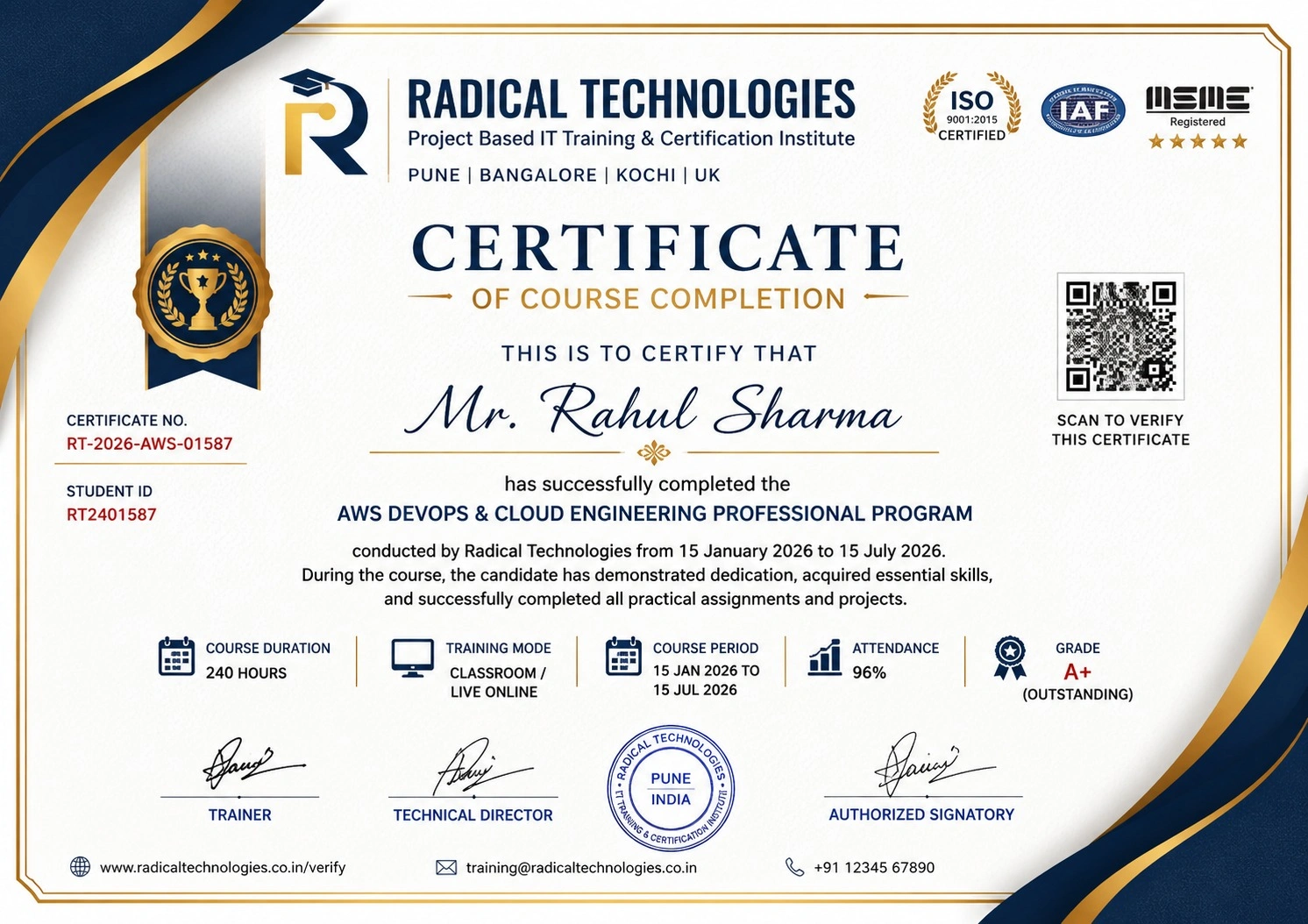
Certificate of Completion

Career Services

At Radical Technologies, we are committed to your success beyond the classroom. Our 100% Job Assistance program ensures that you are not only equipped with industry-relevant skills but also guided through the job placement process. With personalised resume building, interview preparation, and access to our extensive network of hiring partners, we help you take the next step confidently into your IT career.

Career Support

Course Completed? Need next steps?
Need Interview Supports?
Need Job Assistance?
Came from any other Institute?

Join our Brush-up Session & get support until you find a job!

Get Started

Radical Learning Eco-System

Exam Simulator

Cloud SandBox

Hands-on Cloud Lab

Developer Coding Ground

Student Reviews

4.4★
Average learner rating
50K+
Students trained
30+
Hiring companies alumni work at
100%
Placement assistance
4.4
★★★★★

Course Rating

★★★★★
62%
★★★★☆
21%
★★★☆☆
10%
★★☆☆☆
4%
★☆☆☆☆
3%

Our Alumni Work At
Accenture
Amazon
Avisys Services
Birlasoft
Capgemini
Catchpoint
Cognizant
Darwish Cybertech
DataVision
GiBots
Google
Groots Software
HCL Technologies
IBM
Info Gain
Infosys
ITCube Solutions
KPIT
L&T Infotech
Microsoft
Mphasis
mPhatek
Oracle
Quantbit Technologies
Saina Cloud
TCS
Tech Mahindra
Wipro
YASH Technologies
Zensar Technologies
Accenture
Amazon
Avisys Services
Birlasoft
Capgemini
Catchpoint
Cognizant
Darwish Cybertech
DataVision
GiBots
Google
Groots Software
HCL Technologies
IBM
Info Gain
Infosys
ITCube Solutions
KPIT
L&T Infotech
Microsoft
Mphasis
mPhatek
Oracle
Quantbit Technologies
Saina Cloud
TCS
Tech Mahindra
Wipro
YASH Technologies
Zensar Technologies