Radical Technologies
DATA SCIENCE
★★★★★
(2,095 ratings)  50,000+ Student

DATASCIENCE WITH R

Data Science R course effectively covers Data analytics, statistical predictive modelling and machine learning through various practical examples and projects This course does not require a prior quantitative or mathematics background. It starts by introducing basic concepts such as the mean, median mode etc. and eventually covers all aspects of an analytics (or) data science career from analysing and preparing raw data to visualizing your findings. If you’re a programmer or a fresh graduate looking to switch into an exciting new career track, or a data analyst looking to make the transition into the tech industry – this course will teach you the basic to Advance techniques used by real-world industry data scientists.

RT
Radical Technologies
50,000+ English 60 hours Weekdays / Weekends Classroom / Online / Corporate
Online / Classroom

DATASCIENCE WITH R

IT Training Programme

Duration 60 hours
Batch Type Weekdays / Weekends
Mode of Training Classroom / Online / Corporate
Locations Pune, Bangalore, Kochi
Language English
Certification Globally Recognized
Call Now

100% placement assistance

What you'll learn

Understand core concepts and architecture from the ground up
Get hands-on with the tools used by working professionals
Build real-world projects you can add to your portfolio
Learn industry best practices and coding standards
Practice with real datasets and real-world scenarios
Prepare for certification and technical interviews
Work on collaborative, team-based exercises
Apply performance tuning and optimization techniques
Understand how the technology fits into a larger ecosystem
Complete assignments reviewed by mentors

Programme Overview

12 sections covering the complete curriculum — a single, progressive learning arc.

60 hours
Training Duration
12
Core Modules
171
Total Lessons
4.4
Average Rating
50K+
Students Trained
01

Foundations & Core Concepts

Get hands-on with the fundamentals and architecture — the building blocks for everything that follows.

Fundamentals Architecture Setup
02

Hands-On Practical Training

Work through real exercises and assignments designed to mirror what you will do on the job.

Practicals Assignments Labs
03

Real-World Projects

Apply what you have learned to end-to-end projects that go straight into your portfolio.

Projects Portfolio Case Studies
04

Advanced Techniques

Go beyond the basics with advanced concepts, integrations and production-grade practices.

Advanced Integration Best Practices
05

Ecosystem Integration

Understand how this technology connects with the broader tools and platforms used in the industry.

Ecosystem Tools Platforms
06

Performance & Interview Prep

Master optimization techniques and prepare for the technical interview questions employers actually ask.

Optimization Interview Prep Certification

Who is this programme for?

Whether you're already writing code, working with data, or supporting applications today — this programme is built to take you into a DATA SCIENCE role.

Software Developers

Engineers who want to add this skill set to their toolkit

Analysts & Consultants

Professionals moving into a more technical, hands-on role

IT Professionals

System admins and support engineers upskilling into a new domain

Fresh Graduates

CS/IT graduates aiming for a job-ready technical role

Course Curriculum

12 sections  •  171 lessons  •  60 hours

01 Introduction to Data Science With R / Data Importing / Exporting

Introduction to Data Science With R

What is analytics & Data Science?
Common Terms in Analytics
Analytics vs. Data warehousing, OLAP, MIS Reporting
Relevance in industry and need of the hour
Types of problems and business objectives in various industries
How leading companies are harnessing the power of analytics?
Critical success drivers
Overview of analytics tools & their popularity
Analytics Methodology & problem solving framework
List of steps in Analytics projects
Identify the most appropriate solution design for the given problem statement
Project plan for Analytics project & key milestones based on effort estimates
Build Resource plan for analytics project
Why R for data science?

Data Importing / Exporting

Introduction R/R-Studio – GUI
Concept of Packages – Useful Packages (Base & Other packages)
Data Structure & Data Types (Vectors, Matrices, factors, Data frames, and Lists)
Importing Data from various sources (txt, dlm, excel, sas7bdata, db, etc.)
Database Input (Connecting to database)
Exporting Data to various formats)
Viewing Data (Viewing partial data and full data)
Variable & Value Labels – Date Values
02 Data Manipulation / Data Analysis – Visualization

Data Manipulation

Data Manipulation steps
Creating New Variables (calculations & Binning)
Dummy variable creation
Applying transformations
Handling duplicates
Handling missings
Sorting and Filtering
Subsetting (Rows/Columns)
Appending (Row appending/column appending)
Merging/Joining (Left, right, inner, full, outer etc)
Data type conversions
Renaming
Formatting
Reshaping data
Sampling
Data manipulation tools

Data Analysis – Visualization

introduction exploratory data analysis
Descriptive statistics, Frequency Tables and summarization
Univariate Analysis (Distribution of data & Graphical Analysis)
Bivariate Analysis(Cross Tabs, Distributions & Relationships, Graphical Analysis)
Creating Graphs- Bar/pie/line chart/histogram/boxplot/scatter/density etc)
R Packages for Exploratory Data Analysis(dplyr, plyr, gmodes, car, vcd, Hmisc, psych, doby etc)
R Packages for Graphical Analysis (base, ggplot, lattice,etc)
03 Introduction To Statistics / Predictive Modelling

Introduction To Statistics

Basic Statistics – Measures of Central Tendencies and Variance
Building blocks – Probability Distributions – Normal distribution – Central Limit Theorem
Inferential Statistics -Sampling – Concept of Hypothesis Testing
Statistical Methods – Z/t-tests( One sample, independent, paired), Anova, Correlations and Chi-square

Predictive Modelling

Concept of model in analytics and how it is used?
Common terminology used in analytics & modelling process
Popular modelling algorithms
Types of Business problems – Mapping of Techniques
Different Phases of Predictive Modelling
04 Data Exploration For Modeling / Segmentation: Solving Segmentation Problems

Data Exploration For Modeling

DATA PREPARATION
Need of Data preparation
Consolidation/Aggregation – Outlier treatment – Flat Liners – Missing values- Dummy creation – Variable Reduction
Variable Reduction Techniques – Factor & PCA Analysis

Segmentation: Solving Segmentation Problems

Introduction to Segmentation
Types of Segmentation (Subjective Vs Objective, Heuristic Vs. Statistical)
Heuristic Segmentation Techniques (Value Based, RFM Segmentation and Life Stage Segmentation)
Behavioral Segmentation Techniques (K-Means Cluster Analysis)
Cluster evaluation and profiling – Identify cluster characteristics
Interpretation of results – Implementation on new data
05 Linear Regression: Solving Regression Problems / Logistic Regression: Solving Classification Problems

Linear Regression: Solving Regression Problems

Introduction – Applications
Assumptions of Linear Regression
Building Linear Regression Model
Understanding standard metrics (Variable significance, R-square/Adjusted R-square, Global hypothesis ,etc)
Assess the overall effectiveness of the model
Validation of Models (Re running Vs. Scoring)
Standard Business Outputs (Decile Analysis, Error distribution (histogram), Model equation, drivers etc.)
Interpretation of Results – Business Validation – Implementation on new data

Logistic Regression: Solving Classification Problems

Introduction – Applications
Linear Regression Vs. Logistic Regression Vs. Generalized Linear Models
Building Logistic Regression Model (Binary Logistic Model)
Understanding standard model metrics (Concordance, Variable significance, Hosmer Lemeshov Test, Gini, KS, Misclassification, ROC Curve etc)
Validation of Logistic Regression Models (Re running Vs. Scoring)
Standard Business Outputs (Decile Analysis, ROC Curve, Probability Cut-offs, Lift charts, Model equation, Drivers or variable importance, etc)
Interpretation of Results – Business Validation – Implementation on new data
06 Time Series Forecasting: Solving Forecasting Problems / Machine Learning -Predictive Modeling – Basics

Time Series Forecasting: Solving Forecasting Problems

Introduction – Applications
Time Series Components( Trend, Seasonality, Cyclicity and Level) and Decomposition
Classification of Techniques(Pattern based – Pattern less)
Basic Techniques – Averages, Smoothening, etc
Advanced Techniques – AR Models, ARIMA, etc
Understanding Forecasting Accuracy – MAPE, MAD, MSE, etc

Machine Learning -Predictive Modeling – Basics

Introduction to Machine Learning & Predictive Modeling
Types of Business problems – Mapping of Techniques – Regression vs. classification vs. segmentation vs. Forecasting
Major Classes of Learning Algorithms -Supervised vs Unsupervised Learning
Different Phases of Predictive Modeling (Data Pre-processing, Sampling, Model Building, Validation)
Overfitting (Bias-Variance Trade off) & Performance Metrics
Feature engineering & dimension reduction
Concept of optimization & cost function
Overview of gradient descent algorithm
Overview of Cross validation(Bootstrapping, K-Fold validation etc)
Model performance metrics (R-square, Adjusted R-squre, RMSE, MAPE, AUC, ROC curve, recall, precision, sensitivity, specificity, confusion metrics )
07 Unsupervised Learning: Segmentation / Supervised Learning: Decision Trees

Unsupervised Learning: Segmentation

What is segmentation & Role of ML in Segmentation?
Concept of Distance and related math background
K-Means Clustering
Expectation Maximization
Hierarchical Clustering
Spectral Clustering (DBSCAN)
Principle component Analysis (PCA)

Supervised Learning: Decision Trees

Decision Trees – Introduction – Applications
Types of Decision Tree Algorithms
Construction of Decision Trees through Simplified Examples; Choosing the “Best” attribute at each Non-Leaf node; Entropy; Information Gain, Gini Index, Chi Square, Regression Trees
Generalizing Decision Trees; Information Content and Gain Ratio; Dealing with Numerical Variables; other Measures of Randomness
Pruning a Decision Tree; Cost as a consideration; Unwrapping Trees as Rules
Decision Trees – Validation
Overfitting – Best Practices to avoid
08 Supervised Learning: Ensemble Learning / Supervised Learning: Artificial Neural Networks (ANN)

Supervised Learning: Ensemble Learning

Concept of Ensembling
Manual Ensembling Vs. Automated Ensembling
Methods of Ensembling (Stacking, Mixture of Experts)
Bagging (Logic, Practical Applications)
Random forest (Logic, Practical Applications)
Boosting (Logic, Practical Applications)
Ada Boost
Gradient Boosting Machines (GBM)
XGBoost

Supervised Learning: Artificial Neural Networks (ANN)

Motivation for Neural Networks and Its Applications
Perceptron and Single Layer Neural Network, and Hand Calculations
Learning In a Multi Layered Neural Net: Back Propagation and Conjugant Gradient Techniques
Neural Networks for Regression
Neural Networks for Classification
Interpretation of Outputs and Fine tune the models with hyper parameters
Validating ANN models
09 Supervised Learning: Support Vector Machines / Supervised Learning: KNN

Supervised Learning: Support Vector Machines

Motivation for Support Vector Machine & Applications
Support Vector Regression
Support vector classifier (Linear & Non-Linear)
Mathematical Intuition (Kernel Methods Revisited, Quadratic Optimization and Soft Constraints)
Interpretation of Outputs and Fine tune the models with hyper parameters
Validating SVM models

Supervised Learning: KNN

What is KNN & Applications?
KNN for missing treatment
KNN For solving regression problems
KNN for solving classification problems
Validating KNN model
Model fine tuning with hyper parameters
10 Supervised Learning: Naïve Bayes / Text Mining & Analytics

Supervised Learning: Naïve Bayes

Concept of Conditional Probability
Bayes Theorem and Its Applications
Naïve Bayes for classification
Applications of Naïve Bayes in Classifications

Text Mining & Analytics

Taming big text, Unstructured vs. Semi-structured Data; Fundamentals of information retrieval, Properties of words; Creating Term-Document (TxD);Matrices; Similarity measures, Low-level processes (Sentence Splitting; Tokenization; Part-of-Speech Tagging; Stemming; Chunking)
Finding patterns in text: text mining, text as a graph
Natural Language processing (NLP)
Text Analytics – Sentiment Analysis using R
Text Analytics – Word cloud analysis using R
Text Analytics – Segmentation using K-Means/Hierarchical Clustering
Text Analytics – Classification (Spam/Not spam)
Applications of Social Media Analytics
Metrics(Measures Actions) in social media analytics
Examples & Actionable Insights using Social Media Analytics
Important R packages for Machine Learning (caret, H2O, Randomforest, nnet, tm etc)
Fine tuning the models using Hyper parameters, grid search, piping etc.
11 Course Contains / Outline for this course

Course Contains

This course Start with introduction to Data Science and Statistics using R Language. It covers both the aspects of Statistical concepts and the practical implementation using R Language. If you’re new to Programming, don’t worry – the course starts with a crash course to teach you all basic programming concepts. If you’ve done some programming before or you are new in Programming, you should pick it up quickly. This course shows you how to get set up on Microsoft Windows-based PC’s; the sample code will also run on MacOS or Linux desktop systems.

Analytics: Using Spark and Scala you can analyze and explore your data in an interactive environment with fast feedback. The course will show how to leverage the power of RDDs and Data frames to manipulate data with ease.

Machine Learning and Data Science : Data Science With R course effectively covers Data analytics, statistical predictive modelling and machine learning through various practical examples and projects

Real life examples: Every concept is explained with the help of examples, case studies and source code wherever necessary. The examples cover a wide array of topics and range from A/B testing in an Internet company context to the Capital Asset Pricing Model in a quant finance context

Outline for this course

Introduction to Data Science With R
Data Importing / Exporting
Data Manipulation
Data Analysis – Visualization
Introduction To Statistics
Predictive Modelling
Data Exploration For Modeling
Data Preparation
12 Audience for this course
Candidates from various quantitative backgrounds, like Engineering, Finance, Maths, Statistics, Business Management who want R training with detailed focus on Data Science and Machine Learning applications.
Engineering/Management Graduate or Post-graduate Fresher Students who want to make their career in the Data Science Industry or want to be future Data Scientists.
Engineers who want to use a distributed computing engine for batch or stream processing or both
Analysts who want to leverage Spark for analyzing interesting datasets
Data Scientists who want a single engine for analyzing and modelling data
MBA Graduates or business professionals who are looking to move to a heavily quantitative role.
Engineering Graduate/Professionals who want to understand basic statistics and lay a foundation for a career in Data Science
Working Professional or Fresh Graduate who have mostly worked in Descriptive analytics or not work anywhere and want to make the shift to being data scientists
Professionals who’ve worked mostly with tools like Excel and want to learn how to use R for statistical analysis.

Tools & Technologies

Every tool listed here is installed, configured and used in a hands-on lab session.

Core Tools

Hands-On Labs

Practical Environment

Industry-Standard Tools

Real-World Setup

Guided Exercises

Skill Building

Sample Datasets

Practice Material

Practice & Projects

Mini Projects

Applied Practice

Assignments

Mentor Reviewed

Doubt Sessions

Live Support

Career Readiness

Resume Building

Career Support

Mock Interviews

Interview Prep

Certification Prep

Global Recognition

Deployment & Delivery

Production Practices

Real-World Ready

Best Practices

Industry Standards

171+
Hands-On Lessons
12
Core Modules
60 hours
Training Duration
100%
Practical Training

You don't just learn DATASCIENCE WITH R. You ship it.

Three major projects, each mirroring how production teams actually work — from guided foundations to a portfolio-ready capstone.

PROJECT // 01

Guided Foundation Project

Requirement Analysis

Guided Implementation

Mentor Review

Iteration

Foundation Beginner

Apply the fundamentals in a structured, mentor-reviewed project

Take the core concepts from the first half of the curriculum and apply them to a realistic scenario, with guidance and feedback from your mentor at every step.

Structured project brief
Step-by-step implementation
Mentor feedback and review
Documented outcome
Stack Core Concepts Best Practices
PROJECT // 02

Applied Practice Project

Scenario Design

Independent Build

Testing & Validation

Peer Review

Applied Intermediate

Build a more independent project mirroring real production scenarios

Work through a project that combines multiple concepts from the curriculum, closer to how work is actually structured on the job — less hand-holding, more ownership.

End-to-end implementation
Testing and validation
Documentation
Peer/mentor review
Stack Applied Skills Testing
PROJECT // 03

Capstone Project

Planning

End-to-End Build

Review & Refinement

Presentation

Capstone Advanced

Take a project from requirements to a polished, portfolio-ready deliverable

Your final project — plan, build, test and present a complete solution using everything covered in the curriculum, reviewed by mentors before you graduate.

Complete working solution
Presentation-ready documentation
Mentor sign-off
Portfolio-ready deliverable
Stack Full Curriculum Portfolio

All 3 projects go directly into your portfolio & resume — reviewed by mentors before you graduate.

See Sample Project Reports

Upcoming Batches

No upcoming batches scheduled right now. Enquire to get notified.

Why Radical Technologies

Live Online Training
  • Highly practical oriented training
  • Installation support on your system
  • 24/7 Email and Phone support
  • 100% Placement Assistance
  • Global Certification Preparation
  • Trainer-Student Interactive Portal
  • Assignments and Projects by Mentors
Enroll Now
Live Classroom Training
  • Weekend / Weekdays / Morning / Evening batches
  • 80:20 Practical and Theory ratio
  • Real-life Case Studies
  • Easy make-up for missed sessions
  • PSI | Kryterion | Redhat Test Centers
  • Lifetime Video Classroom Access (coming soon)
  • Resume Prep and Mock Interviews
Enroll Now
Self-Paced Training
  • Learn 300+ courses at your own time
  • 50,000+ Satisfied Learners
  • Course Completion Certificate
  • Practical Labs available
  • Mentor Support available
  • Doubt Clearing Session available
  • 10% Discounted Global Certification
Enroll Now

Like the Curriculum? Let's Get Started

Join 50,000+ students already enrolled at Radical Technologies

Enroll Now

Global Certification

Radical Technologies is the leading IT certification institute in Pune, offering globally recognized certifications across various domains. With expert trainers and comprehensive materials, we ensure students gain in-depth knowledge and hands-on experience to excel in their careers. Our certification programs are tailored to meet industry standards — from cloud technologies to data science — empowering individuals to stay ahead in the ever-evolving tech landscape.
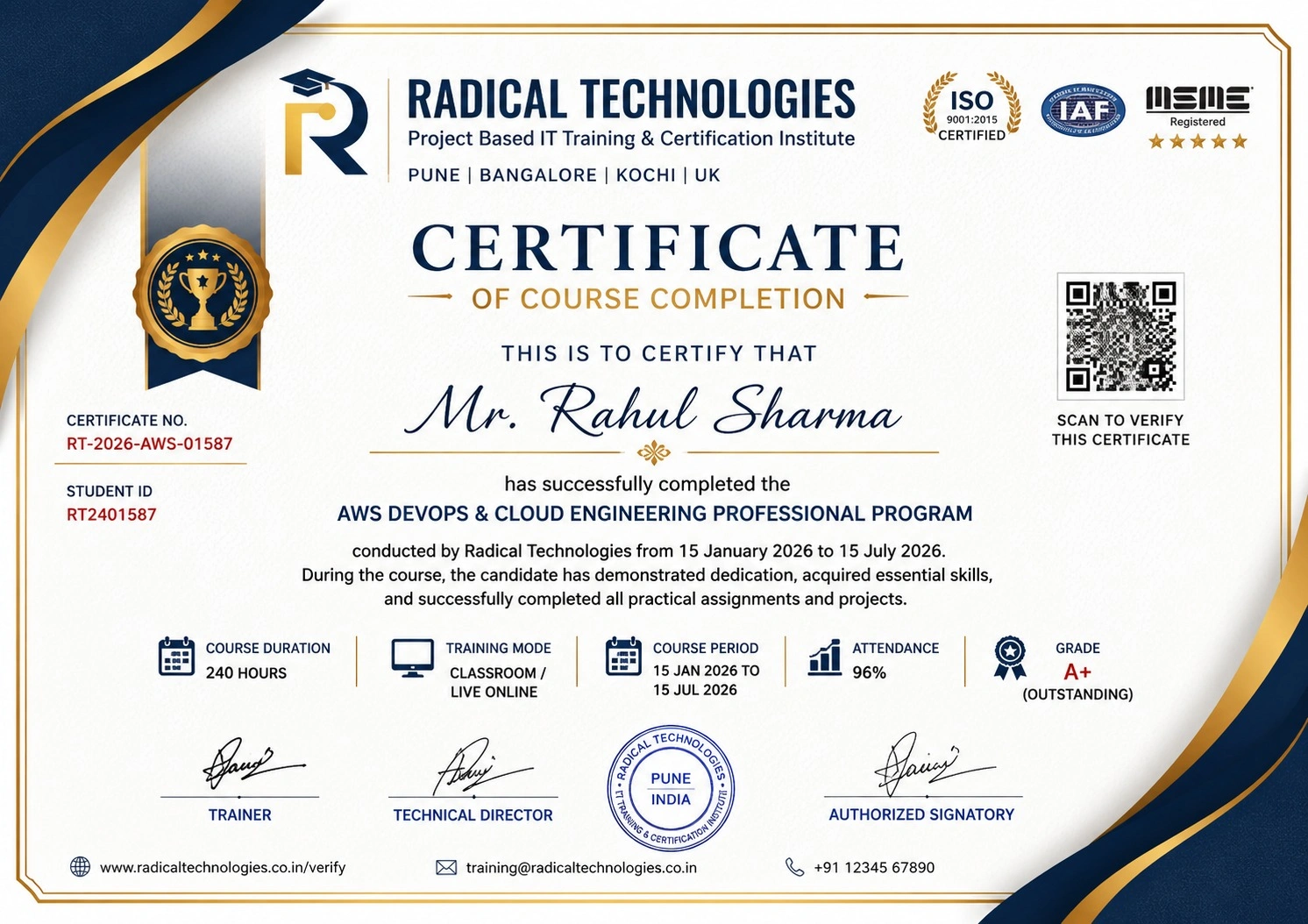
Certificate of Completion

Career Services

At Radical Technologies, we are committed to your success beyond the classroom. Our 100% Job Assistance program ensures that you are not only equipped with industry-relevant skills but also guided through the job placement process. With personalised resume building, interview preparation, and access to our extensive network of hiring partners, we help you take the next step confidently into your IT career.

Career Support

Course Completed? Need next steps?
Need Interview Supports?
Need Job Assistance?
Came from any other Institute?

Join our Brush-up Session & get support until you find a job!

Get Started

Radical Learning Eco-System

Exam Simulator

Cloud SandBox

Hands-on Cloud Lab

Developer Coding Ground

Student Reviews

4.4★
Average learner rating
50K+
Students trained
30+
Hiring companies alumni work at
100%
Placement assistance
4.4
★★★★★

Course Rating

★★★★★
62%
★★★★☆
21%
★★★☆☆
10%
★★☆☆☆
4%
★☆☆☆☆
3%

Our Alumni Work At

Accenture
Amazon
Avisys Services
Birlasoft
Capgemini
Catchpoint
Cognizant
Darwish Cybertech
DataVision
GiBots
Google
Groots Software
HCL Technologies
IBM
Info Gain
Infosys
ITCube Solutions
KPIT
L&T Infotech
Microsoft
Mphasis
mPhatek
Oracle
Quantbit Technologies
Saina Cloud
TCS
Tech Mahindra
Wipro
YASH Technologies
Zensar Technologies
Accenture
Amazon
Avisys Services
Birlasoft
Capgemini
Catchpoint
Cognizant
Darwish Cybertech
DataVision
GiBots
Google
Groots Software
HCL Technologies
IBM
Info Gain
Infosys
ITCube Solutions
KPIT
L&T Infotech
Microsoft
Mphasis
mPhatek
Oracle
Quantbit Technologies
Saina Cloud
TCS
Tech Mahindra
Wipro
YASH Technologies
Zensar Technologies