
AGILE - CERTIFIED SCRUM MASTER
The Scrum Certified Product Owner (CSPO) is a certification offered by Scrum Alliance, a globally recognized organization in the field of Agile and Scrum methodologies. CSPO is a role-focused certification that validates an individual’s expertise in Agile product management and their ability to effectively represent the interests of the customer and stakeholders in a Scrum team. The Scrum Certified Product Owner (CSPO) certification is valuable for professionals who want to excel in the role of a Product Owner in Agile and Scrum environments.
AGILE - CERTIFIED SCRUM MASTER
IT Training Programme
100% placement assistance
What you'll learn
Programme Overview
5 sections covering the complete curriculum — a single, progressive learning arc.
Foundations & Core Concepts
Get hands-on with the fundamentals and architecture — the building blocks for everything that follows.
Hands-On Practical Training
Work through real exercises and assignments designed to mirror what you will do on the job.
Real-World Projects
Apply what you have learned to end-to-end projects that go straight into your portfolio.
Advanced Techniques
Go beyond the basics with advanced concepts, integrations and production-grade practices.
Ecosystem Integration
Understand how this technology connects with the broader tools and platforms used in the industry.
Performance & Interview Prep
Master optimization techniques and prepare for the technical interview questions employers actually ask.
Who is this programme for?
Whether you're already writing code, working with data, or supporting applications today — this programme is built to take you into a MANAGEMENT role.
Software Developers
Engineers who want to add this skill set to their toolkit
Analysts & Consultants
Professionals moving into a more technical, hands-on role
IT Professionals
System admins and support engineers upskilling into a new domain
Fresh Graduates
CS/IT graduates aiming for a job-ready technical role
Course Curriculum
5 sections • 22 lessons • 40 hours
Jump to Section
Total Duration
40 hours
100% Practical · Unlimited Doubt Sessions
01 1. Understanding the Role of the Product Owner
Fundamentals of the Product Owner Role
1.1. Describe the responsibilities of the Product Owner role and the benefits of Scrum Team collaboration.
1.2. Report that the Product Owner helps the organization realize value through delivering product solutions that delight customers and users within the constraints of technical feasibility.
1.3. Describe the Product Owner’s role in the various Scrum events.
1.4. List at least three personal qualities of a Product Owner that support effective delivery and validation of product ideas. Examples: emotional intelligence, collaborative skills, motivating teams, knowledge of Scrum, ability to work and empathize with customers, ability to communicate difficult decisions at all levels, ability to work within an organization to remove impediments, ability to say no, business skills, knowledge of the complete product life cycle, ability to apply the 80/20 rule, conflict management, negotiation skills, ability to influence, ability to make decisions, domain expertise.
1.5. Identify the impact on a Scrum Team and organization of at least three anti-patterns that might exist for Product Owners and report on one. Examples: The Product Owner is viewed as simply an order taker; the Product Owner says, “It’s all important,” focusing only on strategy and handing details off to the Development Team; leaving everything ambiguous, letting the team figure it out with no input; telling the team how to do their job.
1.6. Discuss at least three types of organizational contexts that affect the approach to the Product Owner role and report on one. Examples: A Product Owner has complete ownership of target customer, problem, and solution; a Product Owner owns the delivery of someone else’s idea or initiative; a Product Owner delivers a shared service to other teams in the organization; a Product Owner works on short-term projects that they own the outcome for, etc.
1.7. Explain why Scrum as a framework works for product development and how the Scrum Team delivers product increments. Examples: Discover and evaluate a real-world product idea where the output delivered a successful outcome and used feedback loops to inspect and adapt plans for further value delivery; describe how Scrum reduces risk through inspection and adaptation over short timeframes; describe how Scrum creates an environment where imperfect knowledge and/or decisions are acceptable since Scrum enables error corrections.
Working with Stakeholders
1.8. Use at least one technique to provide transparency to stakeholders on goals and progress. Examples: release burn-up chart, roadmap, sprint reviews, etc.
1.9. List at least three different decision-making approaches a Product Owner might use, depending on their context. Examples: Product Owner decides and informs the team, Product Owner consults the Development Team and/or stakeholders and then decides, Product Owner delegates a decision, etc.
1.10. Define a facilitator and discuss at least two situations where the Product Owner might act as a neutral facilitator and when they might use a different engagement approach.
1.11. List one technique a Product Owner could use when engaging with stakeholders to gather information or insights (e.g., affinity grouping, dot voting, fist of five, open-ended questions, etc.).
Working with the Development Team
1.12. Describe how the Product Owner collaborates with the Development Team on activities such as defining done and backlog creation, refinement, and ordering.
Product Ownership with Multiple Teams
1.13. List at least three techniques for visualizing, managing, or reducing dependencies between teams. Examples: Coordinate with other Product Owners, redefine product backlog items to remove dependencies, ensure product backlogs are visibly shared between Product Owners and Scrum Teams.
02 2. Describing Purpose and Strategy
Product Strategy
2.1. Define the terms purpose, vision, mission, strategy, and tactics in relation to the work. (Note: These terms are debated among experts, so the goal is to discuss and agree on how the terms might be used on the learner’s team.)
2.2. Communicate the purpose of a product idea by describing the problem being solved, who is most affected by the problem, how the team’s efforts will improve the situation, and how that solution’s effectiveness will be evaluated.
2.3. Identify at least two approaches to identify purpose or define strategy. Examples: co-creating, collaborating.
2.4. Explain how strategy is impacted from outside the Scrum Team. Examples: alignment with other parts of the business, hiring, channel partners, cost structure, metrics, etc.
Roadmaps and Release Planning
2.5. Describe at least three different strategies for the incremental delivery of a product. Examples: opportunistic, multi-sprint releases, fixed date or fixed scope, release each sprint, continuous delivery (in sprint), etc.
2.6. Explain how to create a prioritized product roadmap with stakeholders.
2.7. Describe a solution or feature as progressively smaller items that may be completed in a sprint.
03 3. Understanding Customers and Users
Customer Research and Product Discovery
1. Understanding Key Groups
3.1 Compare and contrast the needs of three key groups:Users: Those who actively use the product. They need usability, functionality, and features that solve their specific problems.
Customers: Those who purchase the product. They focus on value for money, ROI, and how the product improves business outcomes.
Stakeholders: Those who benefit indirectly from the product, such as internal teams, investors, or regulatory bodies, often concerned with compliance, market impact, or strategic alignment.
2. Segmentation of Customers and Users
3.2 Illustrate an approach for segmenting customers and users. Example methods:Customer Types: Individual, enterprise, or SMB.
Geography: Regional, global, or country-specific.
Regulatory Bodies: Compliance-driven segmentation (e.g., finance, healthcare).
3. Product Prioritization Strategy
3.3 Describe a strategy for product prioritization:Focused Strategy: Prioritize discovery and delivery for specific user/customer types to deepen engagement and ensure targeted value delivery.
Broad Strategy: Focus on multiple users and customers for wide market coverage but with a higher risk of diluted focus.
4. Building Empathy with Customers
3.4 List three benefits of connecting teams directly to customers and users, such as deeper understanding of needs, improved product design, and increased customer satisfaction.Techniques include:Job Shadowing
Customer Interviews
Usability Testing
5. Describing Users and Customers
3.5 Use a technique to describe users and customers, such as:Empathy Maps: Understand user jobs, pains, and gains.
Personas: Create a fictional representation of target users to guide development.
6. Generating New Product and Feature Ideas
3.6 Describe three techniques for generating ideas and practice one, such as:Design Studio
Brainstorming
Collaborative Customer Games
7. Aspects of Product Discovery
3.7 Identify at least three aspects of product discovery, such as:User Research: Identifying user needs and pain points.
Customer Experience Design: Crafting interactions that delight users.
Usability Engineering: Ensuring ease of use through iterative testing.
8. Techniques for Building Deeper Customer Understanding
3.8 List techniques to connect teams directly to customers and users:Job Shadowing
Customer Observation
Simulating Customer Experience
04 4. Testing Product Assumptions
05 5. Working with the Product Backlog
Differentiating Outcome and Output
Defining Value
Ordering Items
Creating and Refining Items
Tools & Technologies
Every tool listed here is installed, configured and used in a hands-on lab session.
Hands-On Labs
Practical Environment
Industry-Standard Tools
Real-World Setup
Guided Exercises
Skill Building
Sample Datasets
Practice Material
Mini Projects
Applied Practice
Assignments
Mentor Reviewed
Doubt Sessions
Live Support
Resume Building
Career Support
Mock Interviews
Interview Prep
Certification Prep
Global Recognition
Production Practices
Real-World Ready
Best Practices
Industry Standards
You don't just learn AGILE - CERTIFIED SCRUM MASTER. You ship it.
Three major projects, each mirroring how production teams actually work — from guided foundations to a portfolio-ready capstone.
Guided Foundation Project
→Requirement Analysis
→Guided Implementation
→Mentor Review
→Iteration
Apply the fundamentals in a structured, mentor-reviewed project
Take the core concepts from the first half of the curriculum and apply them to a realistic scenario, with guidance and feedback from your mentor at every step.
Applied Practice Project
→Scenario Design
→Independent Build
→Testing & Validation
→Peer Review
Build a more independent project mirroring real production scenarios
Work through a project that combines multiple concepts from the curriculum, closer to how work is actually structured on the job — less hand-holding, more ownership.
Capstone Project
→Planning
→End-to-End Build
→Review & Refinement
→Presentation
Take a project from requirements to a polished, portfolio-ready deliverable
Your final project — plan, build, test and present a complete solution using everything covered in the curriculum, reviewed by mentors before you graduate.
All 3 projects go directly into your portfolio & resume — reviewed by mentors before you graduate.
See Sample Project ReportsUpcoming Batches
Why Radical Technologies
- Highly practical oriented training
- Installation support on your system
- 24/7 Email and Phone support
- 100% Placement Assistance
- Global Certification Preparation
- Trainer-Student Interactive Portal
- Assignments and Projects by Mentors
- Weekend / Weekdays / Morning / Evening batches
- 80:20 Practical and Theory ratio
- Real-life Case Studies
- Easy make-up for missed sessions
- PSI | Kryterion | Redhat Test Centers
- Lifetime Video Classroom Access (coming soon)
- Resume Prep and Mock Interviews
- Learn 300+ courses at your own time
- 50,000+ Satisfied Learners
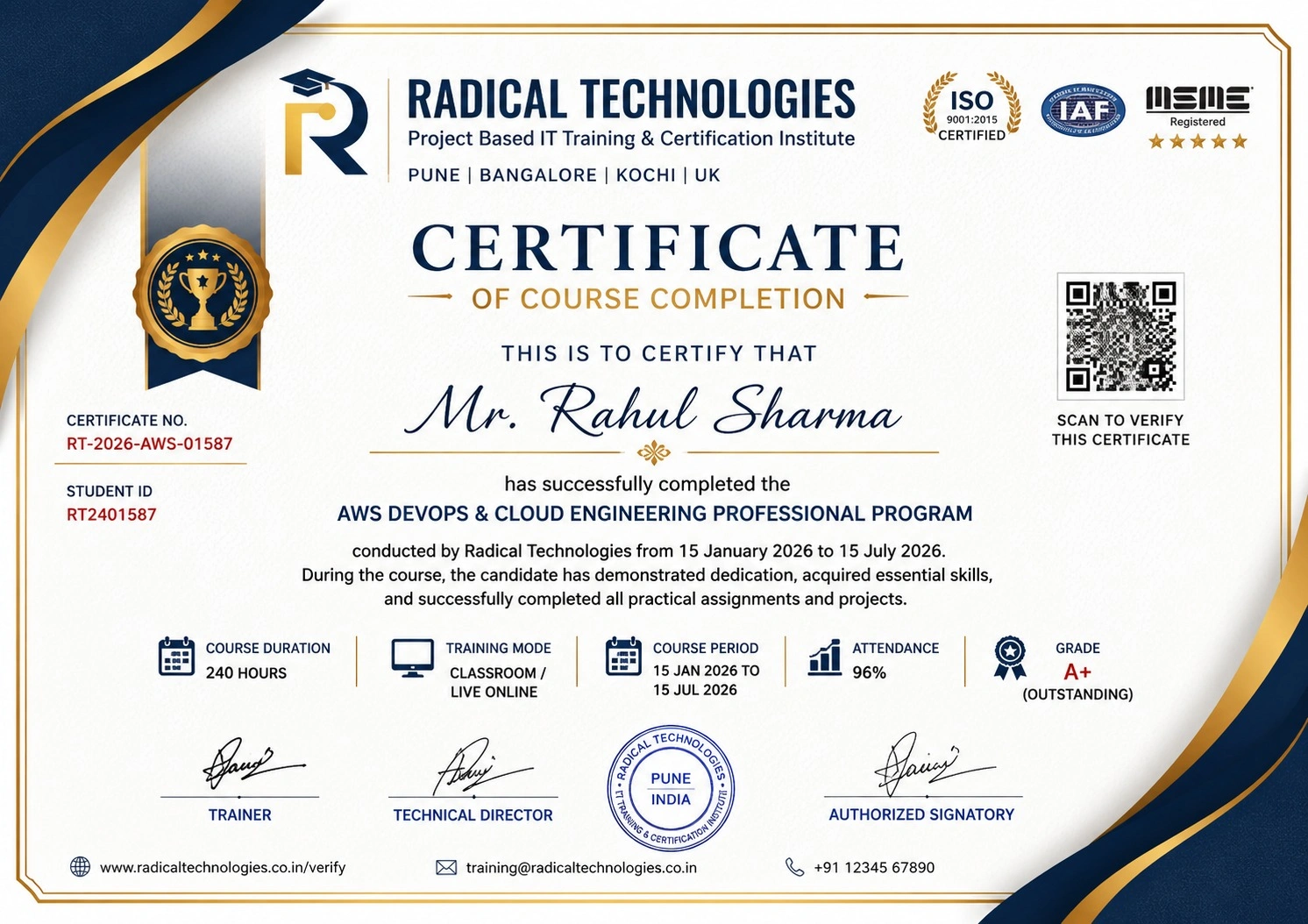
- Course Completion Certificate
- Practical Labs available
- Mentor Support available
- Doubt Clearing Session available
- 10% Discounted Global Certification
Like the Curriculum? Let's Get Started
Join 50,000+ students already enrolled at Radical Technologies
Global Certification
Radical Technologies is the leading IT certification institute in Pune, offering globally recognized certifications across various domains. With expert trainers and comprehensive materials, we ensure students gain in-depth knowledge and hands-on experience to excel in their careers. Our certification programs are tailored to meet industry standards — from cloud technologies to data science — empowering individuals to stay ahead in the ever-evolving tech landscape.
Career Services
At Radical Technologies, we are committed to your success beyond the classroom. Our 100% Job Assistance program ensures that you are not only equipped with industry-relevant skills but also guided through the job placement process. With personalised resume building, interview preparation, and access to our extensive network of hiring partners, we help you take the next step confidently into your IT career.
Career Support
Join our Brush-up Session & get support until you find a job!
Get StartedRadical Learning Eco-System
Exam Simulator
Cloud SandBox
Hands-on Cloud Lab
Developer Coding Ground
Student Reviews
Course Rating





Our Alumni Work At
























Related Courses


AGILE - CERTIFIED SCRUM MASTER Course In Other Cities
Online Batches Available For These Areas
Ambegaon Budruk | Aundh | Baner | Bavdhan Khurd | Bavdhan Budruk | Balewadi | Shivajinagar | Bibvewadi | Bhugaon | Bhukum | Dhankawadi | Dhanori | Dhayari | Erandwane | Fursungi | Ghorpadi | Hadapsar | Hingne Khurd | Karve Nagar | Kalas | Katraj | Khadki | Kharadi | Kondhwa | Koregaon Park | Kothrud | Lohagaon | Manjri | Markal | Mohammed Wadi | Mundhwa | Nanded | Parvati Hill | Panmala | Pashan | Pirangut | Shivane | Sus | Undri | Vishrantwadi | Vitthalwadi | Vadgaon Khurd | Vadgaon Budruk | Vadgaon Sheri | Wagholi | Wanwadi | Warje | Yerwada | Akurdi | Bhosari | Chakan | Charholi Budruk | Chikhli | Chimbali | Chinchwad | Dapodi | Dehu Road | Dighi | Dudulgaon | Hinjawadi | Kalewadi | Kasarwadi | Maan | Moshi | Phugewadi | Pimple Gurav | Pimple Nilakh | Pimple Saudagar | Pimpri | Ravet | Rahatani | Sangvi | Talawade | Tathawade | Thergaon | Wakad
AGILE - CERTIFIED SCRUM MASTER
IT Training Programme
100% placement assistance