Radical Technologies
DEVOPS
★★★★★
(2,095 ratings)  50,000+ Student

AZURE DEVOPS

Azure DevOps is a Software as a service (SaaS) platform from Microsoft that provides an end-to-end DevOps toolchain for developing and deploying software. It also integrates with most leading tools on the market and is a great option for orchestrating a DevOps toolchain. Azure DevOps provides developer services for support teams to plan work, collaborate on code development, and build and deploy applications. Azure DevOps supports a culture and set of processes that bring developers and project managers and contributors together to complete software development.

RT
Radical Technologies
50,000+ English 50 hours Weekdays / Weekends Classroom / Online / Corporate
Online / Classroom

AZURE DEVOPS

IT Training Programme

Duration 50 hours
Batch Type Weekdays / Weekends
Mode of Training Classroom / Online / Corporate
Locations Pune, Bangalore, Kochi
Language English
Certification Globally Recognized
Call Now

100% placement assistance

What you'll learn

Understand core concepts and architecture from the ground up
Get hands-on with the tools used by working professionals
Build real-world projects you can add to your portfolio
Learn industry best practices and coding standards
Practice with real datasets and real-world scenarios
Prepare for certification and technical interviews
Work on collaborative, team-based exercises
Apply performance tuning and optimization techniques
Understand how the technology fits into a larger ecosystem
Complete assignments reviewed by mentors

Programme Overview

18 sections covering the complete curriculum — a single, progressive learning arc.

50 hours
Training Duration
18
Core Modules
114
Total Lessons
4.4
Average Rating
50K+
Students Trained
01

Foundations & Core Concepts

Get hands-on with the fundamentals and architecture — the building blocks for everything that follows.

Fundamentals Architecture Setup
02

Hands-On Practical Training

Work through real exercises and assignments designed to mirror what you will do on the job.

Practicals Assignments Labs
03

Real-World Projects

Apply what you have learned to end-to-end projects that go straight into your portfolio.

Projects Portfolio Case Studies
04

Advanced Techniques

Go beyond the basics with advanced concepts, integrations and production-grade practices.

Advanced Integration Best Practices
05

Ecosystem Integration

Understand how this technology connects with the broader tools and platforms used in the industry.

Ecosystem Tools Platforms
06

Performance & Interview Prep

Master optimization techniques and prepare for the technical interview questions employers actually ask.

Optimization Interview Prep Certification

Who is this programme for?

Whether you're already writing code, working with data, or supporting applications today — this programme is built to take you into a DEVOPS role.

Software Developers

Engineers who want to add this skill set to their toolkit

Analysts & Consultants

Professionals moving into a more technical, hands-on role

IT Professionals

System admins and support engineers upskilling into a new domain

Fresh Graduates

CS/IT graduates aiming for a job-ready technical role

Course Curriculum

18 sections  •  114 lessons  •  50 hours

01 Configure processes and communications (10–15%)

Configure activity traceability and flow of work

Plan and implement a structure for the flow of work and feedback cycles
Identify appropriate metrics related to flow of work, such as cycle times, time to recovery, and lead time
Integrate Azure Pipelines and GitHub Actions with work item tracking tools
Implement traceability policies decided by development
Integrate a repository with Azure Boards

Configure collaboration and communication

Communicate actionable information by using custom dashboards in Azure Boards
Document a project by using tools, such as wikis and process diagrams
Configure release documentation, including release notes and API documentation
Automate creation of documentation from Git history
Configure notifications by using webhooks
02 Design and implement source control (15–20%)

Design and implement a source control strategy

Design and implement an authentication strategy
Design a strategy for managing large files, including Git LFS and git-fat
Design a strategy for scaling and optimizing a Git repository, including Scalar and cross-repository sharing
Implement workflow hooks

Plan and implement branching strategies for the source code

Design a branch strategy, including trunk-based, feature branch, and release branch
Design and implement a pull request workflow by using branch policies and branch protections
Implement branch merging restrictions by using branch policies and branch protections

Configure and manage repositories

Integrate GitHub repositories with Azure Pipelines
Configure permissions in the source control repository
Configure tags to organize the source control repository
Recover data by using Git commands
Purge data from source control
03 Design and implement build and release pipelines (40–45%)

Design and implement pipeline automation

Integrate pipelines with external tools, including dependency scanning, security scanning, and code coverage
Design and implement quality and release gates, including security and governance
Design integration of automated tests into pipelines
Design and implement a comprehensive testing strategy (including local tests, unit tests, integration tests, and load tests)
Design and implement UI testing
Implement orchestration of tools, such as GitHub Actions and Azure Pipelines

Design and implement a package management strategy

Design a package management implementation that uses Azure Artifacts, GitHub Packages, NuGet, and npm
Design and implement package feeds, including upstream sources
Design and implement a dependency versioning strategy for code assets and packages, including semantic versioning and date-based
Design and implement a versioning strategy for pipeline artifacts

Design and implement pipelines

Select a deployment automation solution, including GitHub Actions and Azure Pipelines
Design and implement an agent infrastructure, including cost, tool selection, licenses, connectivity, and maintainability
Develop and implement pipeline trigger rules
Develop pipelines, including classic and YAML

Design and implement a strategy for job execution order, including parallelism and multi-stage

Develop complex pipeline scenarios, such as containerized agents and hybrid
Configure and manage self-hosted agents, including virtual machine (VM) templates and containerization
Create reusable pipeline elements, including YAML templates, task groups, variables, and variable groups
Design and implement checks and approvals by using YAML environments

Design and implement deployments

Design a deployment strategy, including blue/green, canary, ring, progressive exposure, feature flags, and A/B testing
Design a pipeline to ensure reliable order of dependency deployments
Exam AZ-400: Designing and Implementing Microsoft DevOps Solutions
Plan for minimizing downtime during deployments by using VIP swap, load balancer, and rolling deployments
Design a hotfix path plan for responding to high-priority code fixes
Implement load balancing for deployment, including Azure Traffic Manager and the Web Apps feature of Azure App Service
Implement feature flags by using Azure App Configuration Feature Manager
Implement application deployment by using containers, binary, and scripts

Design and implement infrastructure as code (IaC)

Recommend a configuration management technology for application infrastructure
Implement a configuration management strategy for application infrastructure, including IaC
Define an IaC strategy, including source control and automation of testing and deployment
Design and implement desired state configuration for environments, including Azure Automation
State Configuration, Azure Resource Manager, Bicep, and Azure Automanage Machine Configuration

Maintain pipelines

Monitor pipeline health, including failure rate, duration, and flaky tests
Optimize pipelines for cost, time, performance, and reliability
Analyze pipeline load to determine agent configuration and capacity
Design and implement a retention strategy for pipeline artifacts and dependencies
04 Develop a security and compliance plan (10–15%)

Design and implement a strategy for managing sensitive information in automation

Implement and manage service connections
Implement and manage personal access tokens
Implement and manage secrets, keys, and certificates by using Azure Key Vault, GitHub secrets, and Azure Pipelines secrets
Design and implement a strategy for managing sensitive files during deployment
Design pipelines to prevent leakage of sensitive information

Automate security and compliance scanning

Automate analysis of source code by using GitHub code scanning, GitHub secrets scanning, pipeline-based scans, and SonarQube
Automate security scanning, including container scanning and OWASP ZAP
Automate analysis of licensing, vulnerabilities, and versioning of open-source components by using Mend Bolt and GitHub Dependency Scanning
Exam AZ-400: Designing and Implementing Microsoft DevOps Solutions
05 Implement an instrumentation strategy (10–15%)

Configure monitoring for a DevOps environment

Configure and integrate monitoring by using Azure Monitor
Configure and integrate with monitoring tools, such as Azure Monitor and Application Insights
Manage access control to the monitoring platform
Configure alerts for pipeline events

Analyze metrics

Inspect distributed tracing by using Application Insights
Inspect application performance indicators
Inspect infrastructure performance indicators, including CPU, memory, disk, and network
Identify and monitor metrics for business value
Analyze usage metrics by using Application Insights
Interrogate logs using basic Kusto Query Language (KQL) queries
06 Module 1: Introduction to Azure Sentinel
Overview of Azure Sentinel.
• Understanding the role of a SIEM and SOAR solution in cybersecurity.
• Azure Sentinel architecture and components.
07 Module 2: Data Ingestion and Data Connectors
• Configuring data connectors to collect data from various sources.
• Data ingestion best practices.
• Common data sources and their connectors.
08 Module 3: Data Queries and Investigations
• Introduction to Kusto Query Language (KQL).
• Writing queries to analyze and investigate security data.
• Creating custom workbooks for data visualization.
09 Module 4: Alerts and Incidents Management
• Creating and managing security alerts in Azure Sentinel.
• Incident management and response workflows.
• Automation and orchestration of incident response tasks.
10 Module 5: Threat Intelligence and Threat Detection
• Incorporating threat intelligence feeds into Azure Sentinel.
• Customizing and fine-tuning threat detection rules.
• Behavioral analytics and anomaly detection.
11 Module 6: Integration with Azure and Third-Party Services
• Integrating Azure services like Azure Active Directory and Azure Security Center.
• Connecting third-party security solutions.
• Using Logic Apps and Playbooks for automation.
12 Module 7: User and Entity Behavior Analytics (UEBA)
• Understanding UEBA in Azure Sentinel.
• Detecting and responding to suspicious user and entity activities.
• Behavioral profiling and analysis.
13 Module 8: Compliance and Reporting
• Generating compliance reports.
• Meeting regulatory and compliance requirements.
• Auditing and monitoring in Azure Sentinel.
14 Module 9: Advanced Threat Hunting
• Proactive threat hunting techniques.
• Building custom threat hunting queries.
• Leveraging advanced hunting tools and capabilities.
15 Module 10: Security Orchestration and Automation
• Designing and automating security workflows.
• Creating and managing playbooks.
• Integration with Azure Logic Apps.
16 Module 11: Azure Sentinel Deployment and Scaling
• Deployment options for Azure Sentinel.
• Scaling Azure Sentinel for large-scale environments.
• Best practices for managing a Sentinel workspace.
17 Module 12: Real-World Scenarios and Use Cases
• Analyzing real-world cybersecurity scenarios.
• Creating solutions for specific security challenges.
• Case studies and hands-on exercises.
18 Module 13: Azure Sentinel Certification Preparation
• Overview of Azure Sentinel certification (if available).
• Tips and resources for certification exam preparation

Tools & Technologies

Every tool listed here is installed, configured and used in a hands-on lab session.

Core Tools

Hands-On Labs

Practical Environment

Industry-Standard Tools

Real-World Setup

Guided Exercises

Skill Building

Sample Datasets

Practice Material

Practice & Projects

Mini Projects

Applied Practice

Assignments

Mentor Reviewed

Doubt Sessions

Live Support

Career Readiness

Resume Building

Career Support

Mock Interviews

Interview Prep

Certification Prep

Global Recognition

Deployment & Delivery

Production Practices

Real-World Ready

Best Practices

Industry Standards

114+
Hands-On Lessons
18
Core Modules
50 hours
Training Duration
100%
Practical Training

You don't just learn AZURE DEVOPS. You ship it.

Three major projects, each mirroring how production teams actually work — from guided foundations to a portfolio-ready capstone.

PROJECT // 01

Guided Foundation Project

Requirement Analysis

Guided Implementation

Mentor Review

Iteration

Foundation Beginner

Apply the fundamentals in a structured, mentor-reviewed project

Take the core concepts from the first half of the curriculum and apply them to a realistic scenario, with guidance and feedback from your mentor at every step.

Structured project brief
Step-by-step implementation
Mentor feedback and review
Documented outcome
Stack Core Concepts Best Practices
PROJECT // 02

Applied Practice Project

Scenario Design

Independent Build

Testing & Validation

Peer Review

Applied Intermediate

Build a more independent project mirroring real production scenarios

Work through a project that combines multiple concepts from the curriculum, closer to how work is actually structured on the job — less hand-holding, more ownership.

End-to-end implementation
Testing and validation
Documentation
Peer/mentor review
Stack Applied Skills Testing
PROJECT // 03

Capstone Project

Planning

End-to-End Build

Review & Refinement

Presentation

Capstone Advanced

Take a project from requirements to a polished, portfolio-ready deliverable

Your final project — plan, build, test and present a complete solution using everything covered in the curriculum, reviewed by mentors before you graduate.

Complete working solution
Presentation-ready documentation
Mentor sign-off
Portfolio-ready deliverable
Stack Full Curriculum Portfolio

All 3 projects go directly into your portfolio & resume — reviewed by mentors before you graduate.

See Sample Project Reports

Upcoming Batches

No upcoming batches scheduled right now. Enquire to get notified.

Why Radical Technologies

Live Online Training
  • Highly practical oriented training
  • Installation support on your system
  • 24/7 Email and Phone support
  • 100% Placement Assistance
  • Global Certification Preparation
  • Trainer-Student Interactive Portal
  • Assignments and Projects by Mentors
Enroll Now
Live Classroom Training
  • Weekend / Weekdays / Morning / Evening batches
  • 80:20 Practical and Theory ratio
  • Real-life Case Studies
  • Easy make-up for missed sessions
  • PSI | Kryterion | Redhat Test Centers
  • Lifetime Video Classroom Access (coming soon)
  • Resume Prep and Mock Interviews
Enroll Now
Self-Paced Training
  • Learn 300+ courses at your own time
  • 50,000+ Satisfied Learners
  • Course Completion Certificate
  • Practical Labs available
  • Mentor Support available
  • Doubt Clearing Session available
  • 10% Discounted Global Certification
Enroll Now

Like the Curriculum? Let's Get Started

Join 50,000+ students already enrolled at Radical Technologies

Enroll Now

Global Certification

Radical Technologies is the leading IT certification institute in Pune, offering globally recognized certifications across various domains. With expert trainers and comprehensive materials, we ensure students gain in-depth knowledge and hands-on experience to excel in their careers. Our certification programs are tailored to meet industry standards — from cloud technologies to data science — empowering individuals to stay ahead in the ever-evolving tech landscape.
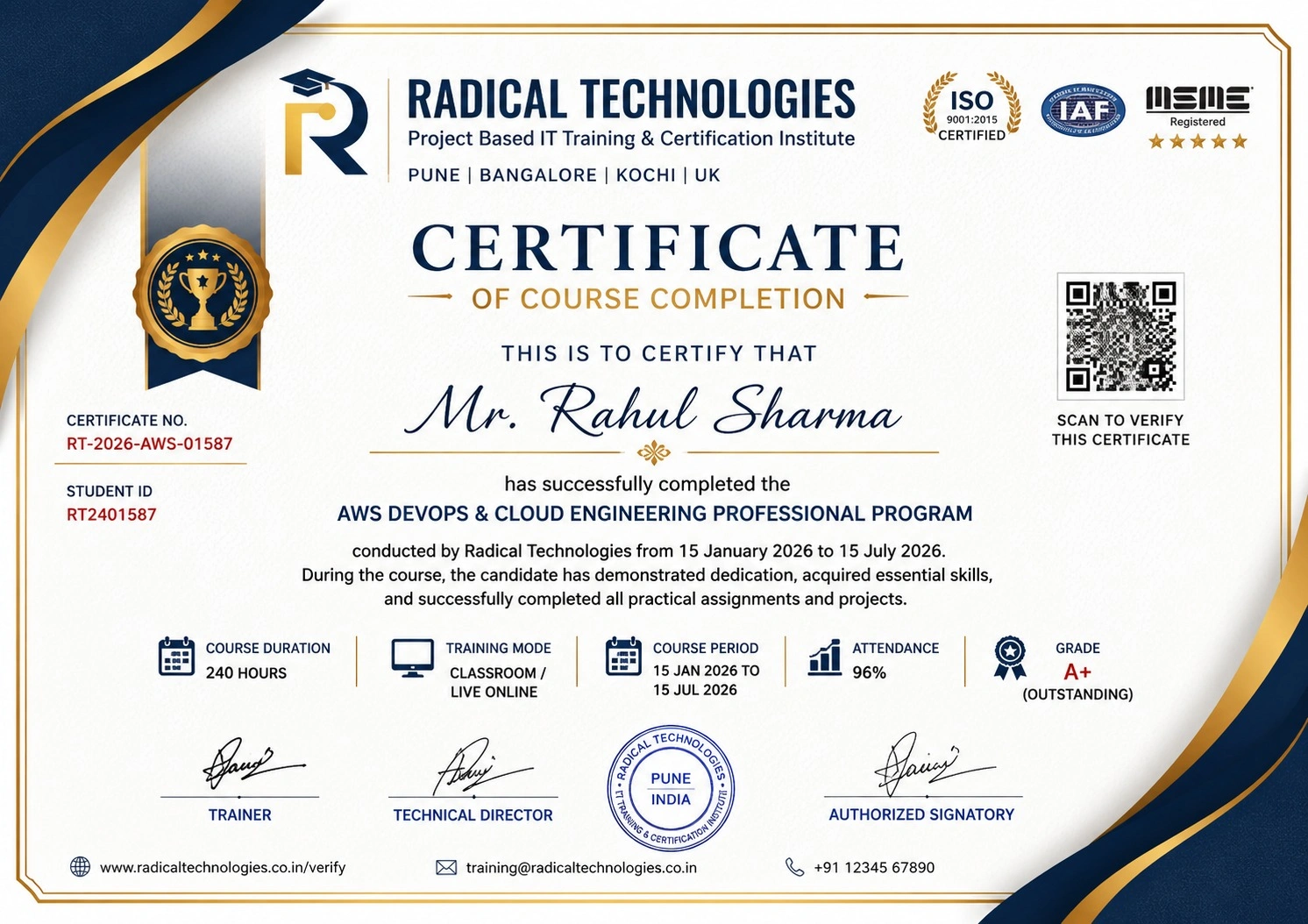
Certificate of Completion

Career Services

At Radical Technologies, we are committed to your success beyond the classroom. Our 100% Job Assistance program ensures that you are not only equipped with industry-relevant skills but also guided through the job placement process. With personalised resume building, interview preparation, and access to our extensive network of hiring partners, we help you take the next step confidently into your IT career.

Career Support

Course Completed? Need next steps?
Need Interview Supports?
Need Job Assistance?
Came from any other Institute?

Join our Brush-up Session & get support until you find a job!

Get Started

Radical Learning Eco-System

Exam Simulator

Cloud SandBox

Hands-on Cloud Lab

Developer Coding Ground

Student Reviews

4.4★
Average learner rating
50K+
Students trained
30+
Hiring companies alumni work at
100%
Placement assistance
4.4
★★★★★

Course Rating

★★★★★
62%
★★★★☆
21%
★★★☆☆
10%
★★☆☆☆
4%
★☆☆☆☆
3%

Our Alumni Work At

Accenture
Amazon
Avisys Services
Birlasoft
Capgemini
Catchpoint
Cognizant
Darwish Cybertech
DataVision
GiBots
Google
Groots Software
HCL Technologies
IBM
Info Gain
Infosys
ITCube Solutions
KPIT
L&T Infotech
Microsoft
Mphasis
mPhatek
Oracle
Quantbit Technologies
Saina Cloud
TCS
Tech Mahindra
Wipro
YASH Technologies
Zensar Technologies
Accenture
Amazon
Avisys Services
Birlasoft
Capgemini
Catchpoint
Cognizant
Darwish Cybertech
DataVision
GiBots
Google
Groots Software
HCL Technologies
IBM
Info Gain
Infosys
ITCube Solutions
KPIT
L&T Infotech
Microsoft
Mphasis
mPhatek
Oracle
Quantbit Technologies
Saina Cloud
TCS
Tech Mahindra
Wipro
YASH Technologies
Zensar Technologies