Radical Technologies
CLOUD COMPUTING - AWS
★★★★★
(2,095 ratings)  50,000+ Student

AWS CERTIFIED CLOUD PRACTITIONER

The AWS Certified Cloud Practitioner certification is an entry-level credential offered by Amazon Web Services (AWS) that provides individuals with a foundational understanding of AWS cloud services and basic cloud computing concepts. It is suitable for individuals at the beginning of their cloud journey and those in non-technical roles who want to gain a basic understanding of AWS.

RT
Radical Technologies
50,000+ English 24 hours Weekdays / Weekends Classroom / Online / Corporate
Online / Classroom

AWS CERTIFIED CLOUD PRACTITIONER

IT Training Programme

Duration 24 hours
Batch Type Weekdays / Weekends
Mode of Training Classroom / Online / Corporate
Locations Pune, Bangalore, Kochi
Language English
Certification Globally Recognized
Call Now

100% placement assistance

What you'll learn

Understand core concepts and architecture from the ground up
Get hands-on with the tools used by working professionals
Build real-world projects you can add to your portfolio
Learn industry best practices and coding standards
Practice with real datasets and real-world scenarios
Prepare for certification and technical interviews
Work on collaborative, team-based exercises
Apply performance tuning and optimization techniques
Understand how the technology fits into a larger ecosystem
Complete assignments reviewed by mentors

Programme Overview

4 sections covering the complete curriculum — a single, progressive learning arc.

24 hours
Training Duration
4
Core Modules
127
Total Lessons
4.4
Average Rating
50K+
Students Trained
01

Foundations & Core Concepts

Get hands-on with the fundamentals and architecture — the building blocks for everything that follows.

Fundamentals Architecture Setup
02

Hands-On Practical Training

Work through real exercises and assignments designed to mirror what you will do on the job.

Practicals Assignments Labs
03

Real-World Projects

Apply what you have learned to end-to-end projects that go straight into your portfolio.

Projects Portfolio Case Studies
04

Advanced Techniques

Go beyond the basics with advanced concepts, integrations and production-grade practices.

Advanced Integration Best Practices
05

Ecosystem Integration

Understand how this technology connects with the broader tools and platforms used in the industry.

Ecosystem Tools Platforms
06

Performance & Interview Prep

Master optimization techniques and prepare for the technical interview questions employers actually ask.

Optimization Interview Prep Certification

Who is this programme for?

Whether you're already writing code, working with data, or supporting applications today — this programme is built to take you into a CLOUD COMPUTING - AWS role.

Software Developers

Engineers who want to add this skill set to their toolkit

Analysts & Consultants

Professionals moving into a more technical, hands-on role

IT Professionals

System admins and support engineers upskilling into a new domain

Fresh Graduates

CS/IT graduates aiming for a job-ready technical role

Course Curriculum

4 sections  •  127 lessons  •  24 hours

01 Cloud concepts – 26%

Define the aws cloud and its value proposition

– define the benefits of the aws cloud including:
Security
Reliability
High availability
Elasticity
Agility
Pay-as-you go pricing
Scalability
Global reach
Economy of scale
– explain how the aws cloud allows users to focus on business value
Shifting technical resources to revenue-generating activities as opposed to managing infrastructure

Identify aspects of aws cloud economics

– define items that would be part of a total cost of ownership proposal
Understand the role of operational expenses (opex)
Understand the role of capital expenses (capex)
Understand labor costs associated with on-premises operations
Understand the impact of software licensing costs when moving to the cloud
– identify which operations will reduce costs by moving to the cloud
Right-sized infrastructure
Benefits of automation
Reduce compliance scope (for example, reporting)
Managed services (for example, rds, ecs, eks, dynamodb)

Explain the different cloud architecture design principles

– explain the design principles
Design for failure
Decouple components versus monolithic architecture
Implement elasticity in the cloud versus on-premises
Think parallel
02 Security and compliance – 25%

Define the aws shared responsibility model

– recognize the elements of the shared responsibility model
– describe the customer’s responsibly on aws
Describe how the customer’s responsibilities may shift depending on the service used (for example with rds, lambda, or ec2)
– describe aws responsibilities

Define aws cloud security and compliance concepts

– identify where to find aws compliance information
Locations of lists of recognized available compliance controls (for example, hippa, socs)
Recognize that compliance requirements vary among aws services
– at a high level, describe how customers achieve compliance on aws
Identify different encryption options on aws (for example, in transit, at rest)
– describe who enables encryption on aws for a given service
– recognize there are services that will aid in auditing and reporting
Recognize that logs exist for auditing and monitoring (do not have to understand the logs)
Define amazon cloudwatch, aws config, and awscloudtrail
– explain the concept of least privileged access

Identify aws access management capabilities

– understand the purpose of user and identity management
Access keys and password policies (rotation, complexity)
Multi-factor authentication (mfa)
Aws identity and access management (iam)
– groups/users
– roles
– policies, managed policies compared to custom policies
Tasks that require use of root accounts
Protection of root accounts

Identify resources for security support

– recognize there are different network security capabilities
Native aws services (for example, security groups, network acls, awswaf)
3rd party security products from the aws marketplace
– recognize there is documentation and where to find it (for example, best practices, whitepapers, official documents)
Aws knowledge center, security center, security forum, and security blogs
Partner systems integrators
– know that security checks are a component of aws trusted advisor
03 Technology – 33%

Define methods of deploying and operating in the aws cloud

– identify at a high level different ways of provisioning and operating in the aws cloud
Programmatic access, apis, sdks, aws management console, cli, infrastructure as code
– identify different types of cloud deployment models
All in with cloud/cloud native
Hybrid
On-premises
– identify connectivity options
Vpn
Aws direct connect
Public internet

Define the aws global infrastructure

– describe the relationships among regions, availability zones, and edge locations
– describe how to achieve high availability through the use of multiple availability zones
Recall that high availability is achieved by using multiple availability zones
Recognize that availability zones do not share single points of failure
– describe when to consider the use of multiple aws regions
Disaster recovery/business continuity
Low latency for end-users
Data sovereignty
– describe at a high level the benefits of edge locations
Amazon cloudfront
Aws global accelerator

Identify the core aws services

– describe the categories of services on aws (compute, storage, network, database)
– identify aws compute services
Recognize there are different compute families
Recognize the different services that provide compute (for example, aws lambda compared to amazon elastic container service (amazon ecs), or amazon ec2, etc.)
Recognize that elasticity is achieved through auto scaling
Identify the purpose of load balancers
– identify different aws storage services
Describe amazon s3
Describe amazon elastic block store (amazon ebs)
Describe amazon s3 glacier
Describe aws snowball
Describe amazon elastic file system (amazon efs)
Describe aws storage gateway
– identify aws networking services
Identify vpc
Identify security groups
Identify the purpose of amazon route 53
Identify vpn, aws direct connect
– identify different aws database services
Install databases on amazon ec2 compared to aws managed databases
Identify amazon rds
Identify amazon dynamodb
Identify amazon redshift

Identify resources for technology support

– recognize there is documentation (best practices, whitepapers, aws knowledge center, forums, blogs)
– identify the various levels and scope of aws support
Aws abuse
Aws support cases
Premium support
Technical account managers
– recognize there is a partner network (marketplace, third-party) including independent software vendors and system integrators
– identify sources of aws technical assistance and knowledge including professional services, solution architects, training and certification, and the amazon partner network
– identify the benefits of using aws trusted advisor
04 Billing and pricing – 16%

Compare and contrast the various pricing models for aws (for example, on-demand instances, reserved instances, and spot instance pricing)

– identify scenarios/best fit for on-demand instance pricing
– identify scenarios/best fit for reserved-instance pricing
Describe reserved-instances flexibility
Describe reserved-instances behavior in aws organizations
– identify scenarios/best fit for spot instance pricing

Recognize the various account structures in relation to aws billing and pricing

– recognize that consolidated billing is a feature of aws organizations
– identify how multiple accounts aid in allocating costs across departments

Identify resources available for billing support

– identify ways to get billing support and information
Cost explorer, aws cost and usage report, amazon quicksight, third-party partners, and aws marketplace tools
Open a billing support case
The role of the concierge for aws enterprise support plan customers
– identify where to find pricing information on aws services
Aws simple monthly calculator
Aws services product pages
Aws pricing api
– recognize that alarms/alerts exist
– identify how tags are used in cost allocation

Tools & Technologies

Every tool listed here is installed, configured and used in a hands-on lab session.

Core Tools

Hands-On Labs

Practical Environment

Industry-Standard Tools

Real-World Setup

Guided Exercises

Skill Building

Sample Datasets

Practice Material

Practice & Projects

Mini Projects

Applied Practice

Assignments

Mentor Reviewed

Doubt Sessions

Live Support

Career Readiness

Resume Building

Career Support

Mock Interviews

Interview Prep

Certification Prep

Global Recognition

Deployment & Delivery

Production Practices

Real-World Ready

Best Practices

Industry Standards

127+
Hands-On Lessons
4
Core Modules
24 hours
Training Duration
100%
Practical Training

You don't just learn AWS CERTIFIED CLOUD PRACTITIONER. You ship it.

Three major projects, each mirroring how production teams actually work — from guided foundations to a portfolio-ready capstone.

PROJECT // 01

Guided Foundation Project

Requirement Analysis

Guided Implementation

Mentor Review

Iteration

Foundation Beginner

Apply the fundamentals in a structured, mentor-reviewed project

Take the core concepts from the first half of the curriculum and apply them to a realistic scenario, with guidance and feedback from your mentor at every step.

Structured project brief
Step-by-step implementation
Mentor feedback and review
Documented outcome
Stack Core Concepts Best Practices
PROJECT // 02

Applied Practice Project

Scenario Design

Independent Build

Testing & Validation

Peer Review

Applied Intermediate

Build a more independent project mirroring real production scenarios

Work through a project that combines multiple concepts from the curriculum, closer to how work is actually structured on the job — less hand-holding, more ownership.

End-to-end implementation
Testing and validation
Documentation
Peer/mentor review
Stack Applied Skills Testing
PROJECT // 03

Capstone Project

Planning

End-to-End Build

Review & Refinement

Presentation

Capstone Advanced

Take a project from requirements to a polished, portfolio-ready deliverable

Your final project — plan, build, test and present a complete solution using everything covered in the curriculum, reviewed by mentors before you graduate.

Complete working solution
Presentation-ready documentation
Mentor sign-off
Portfolio-ready deliverable
Stack Full Curriculum Portfolio

All 3 projects go directly into your portfolio & resume — reviewed by mentors before you graduate.

See Sample Project Reports

Upcoming Batches

No upcoming batches scheduled right now. Enquire to get notified.

Why Radical Technologies

Live Online Training
  • Highly practical oriented training
  • Installation support on your system
  • 24/7 Email and Phone support
  • 100% Placement Assistance
  • Global Certification Preparation
  • Trainer-Student Interactive Portal
  • Assignments and Projects by Mentors
Enroll Now
Live Classroom Training
  • Weekend / Weekdays / Morning / Evening batches
  • 80:20 Practical and Theory ratio
  • Real-life Case Studies
  • Easy make-up for missed sessions
  • PSI | Kryterion | Redhat Test Centers
  • Lifetime Video Classroom Access (coming soon)
  • Resume Prep and Mock Interviews
Enroll Now
Self-Paced Training
  • Learn 300+ courses at your own time
  • 50,000+ Satisfied Learners
  • Course Completion Certificate
  • Practical Labs available
  • Mentor Support available
  • Doubt Clearing Session available
  • 10% Discounted Global Certification
Enroll Now

Like the Curriculum? Let's Get Started

Join 50,000+ students already enrolled at Radical Technologies

Enroll Now

Global Certification

Radical Technologies is the leading IT certification institute in Pune, offering globally recognized certifications across various domains. With expert trainers and comprehensive materials, we ensure students gain in-depth knowledge and hands-on experience to excel in their careers. Our certification programs are tailored to meet industry standards — from cloud technologies to data science — empowering individuals to stay ahead in the ever-evolving tech landscape.
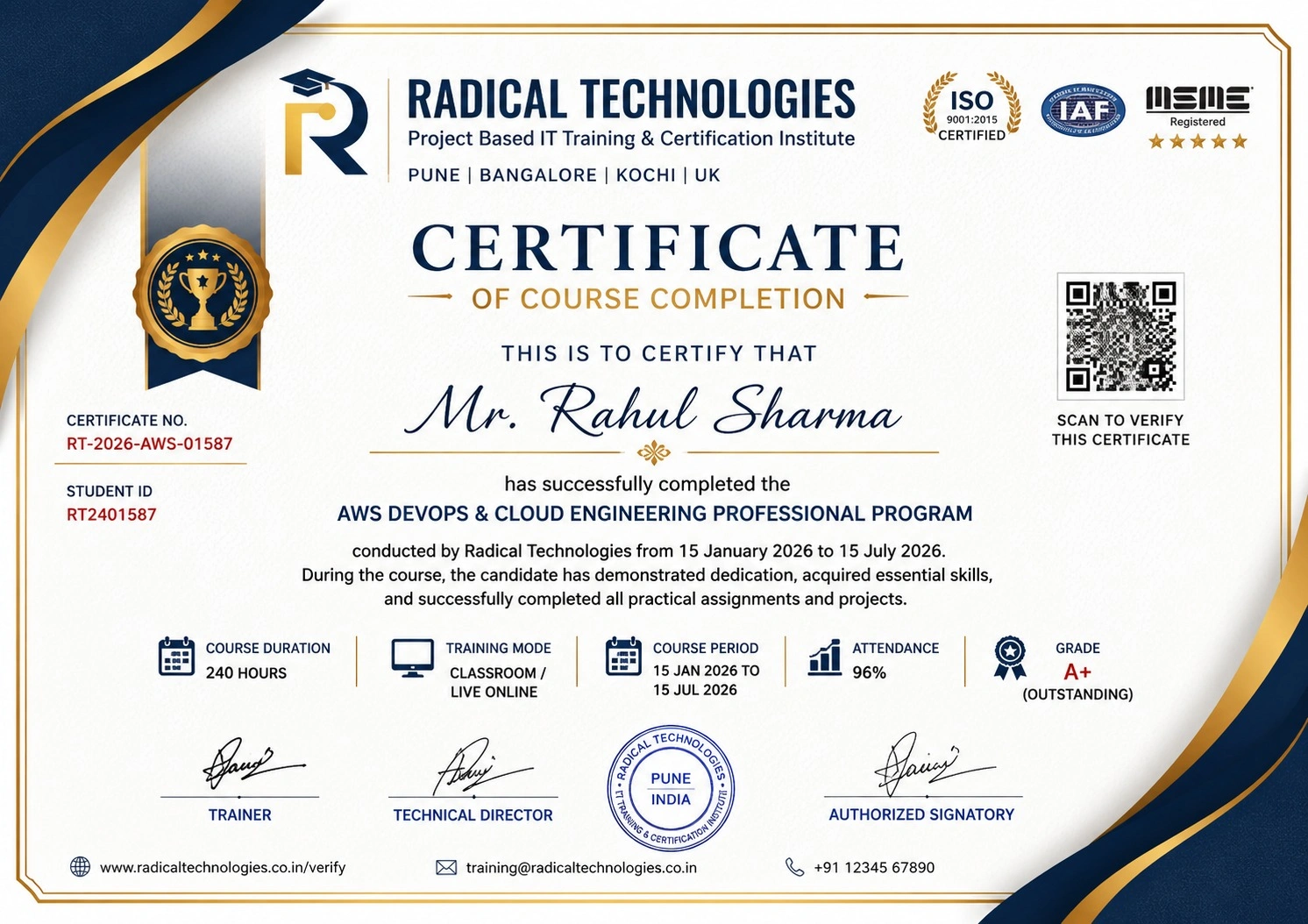
Certificate of Completion

Career Services

At Radical Technologies, we are committed to your success beyond the classroom. Our 100% Job Assistance program ensures that you are not only equipped with industry-relevant skills but also guided through the job placement process. With personalised resume building, interview preparation, and access to our extensive network of hiring partners, we help you take the next step confidently into your IT career.

Career Support

Course Completed? Need next steps?
Need Interview Supports?
Need Job Assistance?
Came from any other Institute?

Join our Brush-up Session & get support until you find a job!

Get Started

Radical Learning Eco-System

Exam Simulator

Cloud SandBox

Hands-on Cloud Lab

Developer Coding Ground

Student Reviews

4.4★
Average learner rating
50K+
Students trained
30+
Hiring companies alumni work at
100%
Placement assistance
4.4
★★★★★

Course Rating

★★★★★
62%
★★★★☆
21%
★★★☆☆
10%
★★☆☆☆
4%
★☆☆☆☆
3%

Our Alumni Work At

Accenture
Amazon
Avisys Services
Birlasoft
Capgemini
Catchpoint
Cognizant
Darwish Cybertech
DataVision
GiBots
Google
Groots Software
HCL Technologies
IBM
Info Gain
Infosys
ITCube Solutions
KPIT
L&T Infotech
Microsoft
Mphasis
mPhatek
Oracle
Quantbit Technologies
Saina Cloud
TCS
Tech Mahindra
Wipro
YASH Technologies
Zensar Technologies
Accenture
Amazon
Avisys Services
Birlasoft
Capgemini
Catchpoint
Cognizant
Darwish Cybertech
DataVision
GiBots
Google
Groots Software
HCL Technologies
IBM
Info Gain
Infosys
ITCube Solutions
KPIT
L&T Infotech
Microsoft
Mphasis
mPhatek
Oracle
Quantbit Technologies
Saina Cloud
TCS
Tech Mahindra
Wipro
YASH Technologies
Zensar Technologies