Radical Technologies
REDHAT LINUX | UNIX
★★★★★
(2,095 ratings)  50,000+ Student

INDUSTRY LINUX CLOUD DEVOPS

This is fundamental course, which covers basic to intermediate as a part of our Linux course. Suitable for freshers OR people who would like to enter into Infra Management related Job. Separate Advanced courses are available for Both AWS and Devops which goes 60 to 80 hours separately each technology

RT
Radical Technologies
50,000+ English 48 weeks Weekdays / Weekends Classroom / Online / Corporate
Online / Classroom

INDUSTRY LINUX CLOUD DEVOPS

IT Training Programme

Duration 48 weeks
Batch Type Weekdays / Weekends
Mode of Training Classroom / Online / Corporate
Locations Pune, Bangalore, Kochi
Language English
Certification Globally Recognized
Call Now

100% placement assistance

What you'll learn

Understand core concepts and architecture from the ground up
Get hands-on with the tools used by working professionals
Build real-world projects you can add to your portfolio
Learn industry best practices and coding standards
Practice with real datasets and real-world scenarios
Prepare for certification and technical interviews
Work on collaborative, team-based exercises
Apply performance tuning and optimization techniques
Understand how the technology fits into a larger ecosystem
Complete assignments reviewed by mentors

Programme Overview

17 sections covering the complete curriculum — a single, progressive learning arc.

48 weeks
Training Duration
17
Core Modules
374
Total Lessons
4.4
Average Rating
50K+
Students Trained
01

Foundations & Core Concepts

Get hands-on with the fundamentals and architecture — the building blocks for everything that follows.

Fundamentals Architecture Setup
02

Hands-On Practical Training

Work through real exercises and assignments designed to mirror what you will do on the job.

Practicals Assignments Labs
03

Real-World Projects

Apply what you have learned to end-to-end projects that go straight into your portfolio.

Projects Portfolio Case Studies
04

Advanced Techniques

Go beyond the basics with advanced concepts, integrations and production-grade practices.

Advanced Integration Best Practices
05

Ecosystem Integration

Understand how this technology connects with the broader tools and platforms used in the industry.

Ecosystem Tools Platforms
06

Performance & Interview Prep

Master optimization techniques and prepare for the technical interview questions employers actually ask.

Optimization Interview Prep Certification

Who is this programme for?

Whether you're already writing code, working with data, or supporting applications today — this programme is built to take you into a REDHAT LINUX | UNIX role.

Software Developers

Engineers who want to add this skill set to their toolkit

Analysts & Consultants

Professionals moving into a more technical, hands-on role

IT Professionals

System admins and support engineers upskilling into a new domain

Fresh Graduates

CS/IT graduates aiming for a job-ready technical role

Course Curriculum

17 sections  •  374 lessons  •  48 weeks

01 Red Hat® Enterprise Linux® 8 includes three Modules:

RHCSA –

• Red Hat System Administration
1 (RH124)
• Red Hat System Administration
I (RH134)

RHCE –

• Red Hat System Administration
III: Linux Automation with
Ansible (RH294)

Total duration: 80 hrs of training (90% Practical & 10% Theory)

Red Hat System Administration I (RH124) –

Red Hat System Administration I provides a foundation for students wishing to become full-time
Linux system administrators by introducing key command line concepts and other enterprise-level tools. These concepts are further developed in the follow-on course, Red Hat System Administration II (RH134).

Prerequisites:

There are no formal prerequisites for this course; however, previous operating system administration experience will be very beneficial.

Get started with Red Hat

Enterprise Linux
Describe and define open source, Linux distributions, and Red Hat Enterprise Linux.

Access the command line

Log into a Linux system and run simple commands using the shell.

Manage files from the command line

Copy, move, create, delete, and organize files while working from the bash shell.

Get help in Red Hat Enterprise Linux

Resolve problems by using local help systems.

Create, view, and edit text files

Manage text files from command output or in a text editor.

Manage local users and groups

Create, manage, and delete local users and groups, as well as administer local password policies.

Control access to files

Set Linux file system permissions on files and interpret the security effects of different permission settings.

Monitor and manage Linux processes

Evaluate and control processes running on a Red Hat Enterprise
Linux system.

Control services and daemons

Control and monitor network services and system daemons using systemd

Configure and secure SSH

Configure secure command line service on remote systems, using OpenSSH.

Analyze and store logs

Locate and accurately interpret logs of system events for troubleshooting purposes.

Manage networking

Configure network interfaces and
000 O
settings on Red Hat Enterprise
Linux servers.

Archive and transfer files

Archive and copy files from one system to another.

Install and update software

Download, install, update, and manage software packages from Red Hat and yum package repositories.

Access Linux files systems

Access, inspect, and use existing file systems on storage attached to a Linux server.

Analyze servers and get support

Investigate and resolve issues in the web-based management interface, getting support from Red Hat to help solve problems.

Comprehensive review

Review the content covered in this course by completing hands-on exercises.
02 Impact on the organization
This course is intended to develop the skills needed for basic administration and configuration of Red Hat Enterprise Linux. This course introduces key command line concepts and enterprise-level tools, laying the foundation for the rapid deployment of Red Hat Enterprise Linux. The curriculum also introduces the basic administration skills needed for resolving configuration issues and integrating Red Hat Enterprise Linux systems with other existing environments.
This offering lays the foundation for secure user and group administration, and develops skills that allow administrators to use available storage solutions more efficiently and securely. This course is the first of a two-part series that turns a computer professional who knows nothing about Linux into a fully capable Linux administrator.
Red Hat has created this course in a way intended to benefit our customers, but each company and infrastructure is unique, and actual results or benefits may vary.
03 Impact of this training
As a result of attending this course, you should be able to perform essential Linux administration tasks, including installation, establishing network connectivity, managing physical storage, and basic security administration.

You should be able to demonstrate these skills:

• Access the command line
• Manage files from command line
Create, view, and edit text files
Manage local users and groups
• Monitor and manage Linux processes
• Control services and daemons
• Control access to files with file system permissions
Analyze and store log files
• Configure and secure the
OpenSSH service
• Install and update software packages
Access Linux file systems
• Manage Linux networking

Recommended next exam or course:

Red Hat System Administration II (RH134) or Red Hat System Administration II with RHCSA exam (RH135)
04 Course description
The first of two courses covering the core system administration tasks needed to manage Red Hat
Enterprise Linux servers
Red Hat System Administration I (RH124) equips you with Linux® administration “survival skills” by focusing on foundational Linux concepts and core tasks. You will learn how to apply command-line concepts and enterprise-level tools, starting you on your journey toward becoming a full-time Linux system administrator.
This path continues with the follow-on course, Red Hat System Administration II (RH134).
This course is based on Red Hat®
Enterprise Linux 8.

Course content summary:

• Introduction to the command line
• Managing physical storage
• Install and configure software components and services
• Establish network connections and control firewall restrictions
• Monitor and manage running processes
• Manage and secure files and file systems
• Administer users and groups
Review the system log files and
journal for issues
• Troubleshoot problems and analyze systems with Red Hat
Insights
• Remotely manage systems with
SSH and the Web Console
05 Prerequisites for this course
Basic technical user skills with computer applications on some operating systems are expected.

System Administration II (RH134)

This module goes deeper into enterprise Linux administration including file systems and partitioning, logical volumes, SELinux, firewalling, and troubleshooting. Attending both
Red Hat System Administration land Red Hat System
Administration II can help you in your preparation for the Red Hat
Certified System Administrator exam (EX200).
06 Outline for this course

Improve command line productivity

Run commands more efficiently by using advanced features of the bash shell, shell scripts, and various utilities provided by Red setting tuning parameters and adjusting scheduling priority of processes.
Control access to files with ALs
Interpret and set access control lists (ACLs) on files to handle situations requiring complex user and group access permissions.
Manage SELinux security
Protect and manage the security of a server by using SELinux.
Maintain basic storage
Create and manage storage devices, partitions, file systems, and swap spaces from the command line.
Manage logical volumes
Create and manage logical
Logical Volume Management
Hat Enterprise Linux.

Schedule future tasks

Schedule commands to run in the future, either one time or on a repeating schedule.

Tune system performance

Improve system performance by setting tuning parameters and adjusting scheduling priority of processes.

Control access to files with ALs

Interpret and set access control lists (ACLs) on files to handle situations requiring complex user and group access permissions.

Manage SELinux security

Protect and manage the security of a server by using SELinux.
Maintain basic storage
Create and manage storage devices, partitions, file systems, and swap spaces from the command line.

Manage logical volumes

Create and manage logicalvolumes containing file systems and swap spaces from the command line.

Implement advanced storage features

Manage storage using the Stratis local storage management system and use VDO volumes to optimize storage space in use.

Access network-attached storage

Use the NFS protocol to administer network-attached storage.

Control the boot process

Manage the boot process to control services offered and to troubleshoot and repair problems

Manage network security

Control network connections to services using the system firewall and SELinux rules.

Install Red Hat Enterprise Linux

Install Red Hat Enterprise Linux on servers and virtual machines.
07 Course description

Focuses on the key tasks needed to become a full-time Linux administrator

Red Hat System Administration

I (RH134) builds upon and lends context to the foundational knowledge established in Red
Hat System Administration I (RH124). This follow-on course demonstrates more detailed use
cases for Red Hat® Enterprise Linux®, preparing you for the Red Hat Certified System Administrator exam (EX200).
This course is based on Red Hat
Enterprise Linux 8.

Course content summary

• Install Red Hat Enterprise Linux using scalable methods
• Access security files, file systems, and networks
• Execute shell scripting and automation techniques
• Manage storage devices, logical volumes, and file systems
• Manage security and system access
• Control the boot process and system services
08 Audience for this course
This course is geared toward
Windows system administrators, network administrators, and other system administrators who are interested in supplementing current skills or backstopping other team members, in addition to Linux system administrators who are responsible for these tasks:
• Configuring, installing, upgrading, and maintaining
Linux systems using established standards and procedures
Providing operational support
• Managing systems for monitoring system performance and availability
• Writing and deploying scripts for task automation and system administration

Prerequisite(s) for this course:

Successful completion of Red Hat
System Administration I (RH124) is recommended. Experienced Linux administrators seeking to accelerate their path toward becoming a Red Hat Certified System Administrator should start with the RHCSA Rapid Track course (RH199).
09 Red Hat System Administration III: Linux Automation with Ansible (RH294)

Course description:

Learn how to automate Linux system administration tasks with Ansible
Red Hat System Administration
II: Linux Automation with Ansible
(RH294 teaches the skills needed to manage large numbers of systems and applications efficiently and consistently. You will learn the techniques needed to use Ansible® to automate provisioning, configuration, application deployment, and orchestration.
This course is based on Red Hat®
Enterprise Linux® 8 and Red Hat
Ansible Engine 2.8.

Course Content Summary:

• Install Ansible / Red Hat Ansible
Engine on control nodes.
Create and update inventories of managed hosts and manage connections to them.
• Automate administration tasks with Ansible Playbooks and ad hoc commands.
• Write effective playbooks at scale
• Protect sensitive data used by
Ansible with Ansible Vault.
Reuse code and simplify playbook development with
Ansible roles.
10 Outline for this course

Introduce Ansible

Describe

Deploy Ansible

Configure Ansible to manage hosts and run ad hoc Ansible commands.

Implement playbooks

Write a simple Ansible Playbook and run it to automate tasks on multiple managed hosts

Manage variables and facts

Write playbooks that use variables to simplify management of the playbook and facts to reference information about managed hosts.

Implement task control

Manage task control, handlers, and task errors in Ansible Playbooks

Deploy files to managed hosts

Deploy, manage, and adjust files on hosts managed by Ansible.

Manage large projects

Write playbooks that are optimized for larger, more
complex projects.

Simplify playbooks with roles

Use Ansible roles to develop playbooks more auickly and to reuse Ansible code.

Troubleshoot Ansible

Troubleshoot playbooks and managed hosts.

Automate Linux administration tasks

Automate common Linux system administration tasks with Ansible.

Impact on the organization

IT automation is key to managing large numbers of systems and applications efficiently and consistently at scale. This course develops the skills needed to efficiently operate and more easily scale the organization’s dynamic
IT infrastructure, accelerate application time to value, and rapidly adapt and implement needed innovation through
DevOps practices.
Red Hat has created this course in a way intended to benefit our customers, but each company and infrastructure is unique, and actual results or benefits may vary.
11 Impact on the individual
As a result of attending this course, you should be able to use Ansible for the purpose of automation, configuration, and management.
You should be able to demonstrate these skills:
• Install and configure Ansible or
Red Hat Ansible Engine on a contro node.
Create and manage inventories of managed hosts, as well as prepare them for Ansible automation.
• Run individual ad hoc automation tasks from the command line.
• Write Ansible Playbooks to consistently automate multiple tasks and apply them to managed hosts.
• Parameterize playbooks using variables and facts, and protect sensitive data with Ansible Vault.
• Write and reuse existing Ansible roles to simplify playbook creation and reuse code.
• Automate common Red
Hat Enterprise Linux system administration tasks using
Ansible.
12 Recommended next exam or course
Red Hat Certified Engineer (RHCE) exam on Red Hat Enterprise Linux 8 (EX294)
Advanced Automation: Ansible Best Practices (DO447)

Our Specialty:

• 100% Passing Records of RHEL 7
• Training By 16+ Years experienced Real Time Trainer
• 300+ Practical Sessions
• 100+ Scenarios and Assignments
• World class training methods
• Training until the candidate get placed
• Certification and Placement Support
• All training in reasonable cost
• 10000+ Satisfied candidates
• 5000+ Placement Records
• Corporate and Online Training in reasonable Cost
• Complete End-to-End Project with Each Course
• Data Center with Cisco UCS Servers
• World Class Lab Facility which facilitates 13 /15 /17 Servers
• Resume And Interview preparation with 100% Hands-on Practical sessions
• Doubt clearing sessions any time after the course
• Happy to help you any time after the course
13 Cloud Computing & Devops- 10 Hrs
• Definition and characteristics of cloud computing
• Cloud service models: laaS, PaaS, Saas
• Cloud deployment models: public, private, hybrid
• Benefits and challenges of cloud computing
• Cloud Infrastructure and Platforms
• Virtualization and containers
• Cloud providers and popular platforms (e.g., AWS, Azure, Google Cloud)
• Provisioning and managing cloud resources
•Networking and security in the cloud
• Application Development and Deployment in the Cloud
• Cloud-native application
• Containerization and orchestration (e.g., Docker, Kubernetes)
• Serverless computing
• Scalability and high availability
14 Introduction to DevOps
• Definition and principles of DevOps
• Collaboration and communication in DevOps teams
• Benefits of DevOps practices
• DevOps tools and technologies overview
• Continuous Integration and Delivery
• Version control systems (e.g., Git)
• Building and testing automation
• CI/CD pipelines
• Artifact management
• Infrastructure as Code
• Configuration management tools (e.g., Ansible, Chef, Puppet)
• Infrastructure provisioning and automation
• Infrastructure testing and versioning
• Infrastructure as Code best practices
• Monitoring and Logging
• Application performance monitoring
• Log aggregation and analysis
• Infrastructure and resource monitoring
• Alerting and incident response
• Security and Compliance in the Cloud
• Cloud security models and shared responsibility
• Identity and access management
• Security monitoring and auditing
• Compliance frameworks and best practices
• Cloud Migration and Hybrid Environments
• Strategies and considerations for migrating to the cloud
• Hybrid cloud architectures
• Cloud cost management and optimization
• Cloud vendor lock-in and interoperability
• Emerging Trends and Future of Cloud and DevOps
• Serverless computing and edge computing
• Al and machine learning in DevOps
• DevSecOps and security automation
• DevOps culture and organizational transformation
15 Introduction to Cloud Computing
•  Definition and characteristics of cloud computing
• Cloud service models: laaS,PaaS, Saas
• Cloud deployment models:public, private, hybrid
• Benefits and challenges of cloud computing
• Cloud Infrastructure and Platforms
• Virtualization and containers
• Cloud providers and popular platforms (e.g., AWS, Azure, Google Cloud)
• Provisioning and managing cloud resources
• Networking and security in the cloud
• Application Development and Deployment in the Cloud
• Cloud-native application development
• Containerization and orchestration (e.g., Docker, Kubernetes)
• Serverless computing
• Scalability and high availability
• Introduction to DevOps
• Definition and principles of DevOps
• Collaboration and communication in DevOps teams
• Benefits of DevOps practices
• DevOps tools and technologies overview
• Continuous Integration and Delivery
• Version control systems (e.g.,Git)
• Building and testing automation
• CI/CD pipelines
• Artifact management
• Infrastructure as Code
• Configuration management
• Infrastructure provisioning and automation
• Infrastructure testing and versioning
• Infrastructure as Code best practices
• Monitoring and Logging
• Application performance monitoring
• Log aggregation and analysis
• Infrastructure and resource monitoring
• Alerting and incident response
• Security and Compliance in the cloud
• Cloud security models and shared responsibility
• Identity and access management
• Security monitoring and auditing
• Compliance frameworks and best practices
• Cloud Migration and Hybrid Environments
• Strategies and considerations for migrating to the cloud
• Hybrid cloud architectures
• Cloud cost management and optimization
• Cloud vendor lock-in and interoperability
•Emerging Trends and Future of Cloud and DevOps
• Serverless computing and edge computing
• Al and machine learning in DevOps
• DevSecOps and security automation
• DevOps culture and organizational transformation
• Assessment Methods:
16 AWS Fundamentals syllabus- 20 Hrs

Introduction to Cloud Computing and AWS

• Definition and characteristics of cloud computing
• Overview of AWS and its global infrastructure
• AWS service categories and use cases
• AWS pricing and billing model
• AWS Identity and Access Management (IAM)
• AM concepts and components
• User and group management
• IAM policies and permissions
• Best practices for IAM security
• AWS Compute Services
• Amazon Elastic Compute Cloud (EC2)
• EC2 instance types and pricing options
• Auto Scaling and Elastic Load Balancing (ELB)
• Serverless computing with AWS Lambda
• AWS Storage Services
• Amazon Simple Storage Service (S3)
• S3 storage classes and features
• Amazon Elastic Block Store (EBS)
• AWS Glacier and Storage Gateway
• AWS Database Services
• Amazon Relational Database Service (RDS)
• RDS database engines (MySQL,PostgreSQL, Oracle, SQL Server)
• Amazon DynamoDB
• Amazon Redshift and Aurora
• AWS Networking Services
• Amazon Virtual Private Cloud (VPC)
• Subnets, security groups, and network ACLs
• VPC peering and VPN connections
• AWS Direct Connect
• AWS Management and Monitoring
• AWS Management Console and Command Line Interface (CLI)
• AWS CloudFormation
• AWS CloudWatch for monitoring and logging
• AWS Trusted Advisor and AWS Config
• AWS Security and Compliance
• AWS shared responsibility model
• Security groups and network access control
• AWS Web Application Firewall(WAF)
• Encryption services (S3, EBS,RDS)
• AWS Application Services
• Amazon Simple Queue Service (SOS)
• Amazon Simple Notification Service (SNS)
• Amazon Simple Workflow Service (SWF)
• Amazon Simple Email Service (SES)
• AWS Deployment and Management
• AWS Elastic Beanstalk
• AWS OpsWorks
• AWS CloudFormation for infrastructure as code
• Continuous integration and deployment with AWS CodePipeline
17 DevOps Fundamentals – 20 Hrs

Introduction to DevOps

• Definition and principles of DevOps
• Benefits of DevOps practices
• DevOps culture and collaboration
• DevOps and Agile methodologies
• Continuous Integration and Delivery
• Version control systems (e.g., Git)
• Building and testing automation
• CI/CD pipelines
• Artifact management
• Infrastructure as Code
• Configuration management tools (e.g., Ansible, Chef, Puppet)
• Infrastructure provisioning and automation
• Infrastructure testing and versioning
• Infrastructure as Code best practices
• Continuous Deployment and Release Management
• Release pipelines and deployment strategies
• Automated deployment tools (e.g., Jenkins, Bamboo)
• Environment management and configuration
• Rollbacks and monitoring during deployment
• Monitoring and Logging
• Application performance monitoring
• Log aggregation and analysis
• Infrastructure and resource monitoring
• Alerting and incident response
• Collaboration and Communication Tools
• Version control collaboration (e.g., GitLab, GitHub)
• Communication and collaboration platforms (e.g., Slack, Microsoft Teams)
• Issue tracking and project management tools (e.g., Jira, Trello)
• DevOps for Cloud Environments
• Cloud computing and DevOps
• Infrastructure automation in the cloud
• Scalability and elasticity considerations
• Cloud-native application development
• Security and Compliance in DevOps
• DevSecOps principles and practices
• Security testing and vulnerability scanning
• Compliance frameworks and considerations
• Secrets management and access control
• Performance Optimisation and Scalability
• Performance testing and optimisation techniques
• Horizontal and vertical scaling
• Load balancing and auto- scaling
• Caching and content delivery networks (CDNs)
• Continuous Improvement and DevOps Culture
• DevOps feedback loops and metrics
• Post-implementation reviews and retrospectives
• Continuous learning and knowledge sharing
• DevOps adoption and organizational change management

Tools & Technologies

Every tool listed here is installed, configured and used in a hands-on lab session.

Core Tools

Hands-On Labs

Practical Environment

Industry-Standard Tools

Real-World Setup

Guided Exercises

Skill Building

Sample Datasets

Practice Material

Practice & Projects

Mini Projects

Applied Practice

Assignments

Mentor Reviewed

Doubt Sessions

Live Support

Career Readiness

Resume Building

Career Support

Mock Interviews

Interview Prep

Certification Prep

Global Recognition

Deployment & Delivery

Production Practices

Real-World Ready

Best Practices

Industry Standards

374+
Hands-On Lessons
17
Core Modules
48 weeks
Training Duration
100%
Practical Training

You don't just learn INDUSTRY LINUX CLOUD DEVOPS. You ship it.

Three major projects, each mirroring how production teams actually work — from guided foundations to a portfolio-ready capstone.

PROJECT // 01

Guided Foundation Project

Requirement Analysis

Guided Implementation

Mentor Review

Iteration

Foundation Beginner

Apply the fundamentals in a structured, mentor-reviewed project

Take the core concepts from the first half of the curriculum and apply them to a realistic scenario, with guidance and feedback from your mentor at every step.

Structured project brief
Step-by-step implementation
Mentor feedback and review
Documented outcome
Stack Core Concepts Best Practices
PROJECT // 02

Applied Practice Project

Scenario Design

Independent Build

Testing & Validation

Peer Review

Applied Intermediate

Build a more independent project mirroring real production scenarios

Work through a project that combines multiple concepts from the curriculum, closer to how work is actually structured on the job — less hand-holding, more ownership.

End-to-end implementation
Testing and validation
Documentation
Peer/mentor review
Stack Applied Skills Testing
PROJECT // 03

Capstone Project

Planning

End-to-End Build

Review & Refinement

Presentation

Capstone Advanced

Take a project from requirements to a polished, portfolio-ready deliverable

Your final project — plan, build, test and present a complete solution using everything covered in the curriculum, reviewed by mentors before you graduate.

Complete working solution
Presentation-ready documentation
Mentor sign-off
Portfolio-ready deliverable
Stack Full Curriculum Portfolio

All 3 projects go directly into your portfolio & resume — reviewed by mentors before you graduate.

See Sample Project Reports

Upcoming Batches

No upcoming batches scheduled right now. Enquire to get notified.

Why Radical Technologies

Live Online Training
  • Highly practical oriented training
  • Installation support on your system
  • 24/7 Email and Phone support
  • 100% Placement Assistance
  • Global Certification Preparation
  • Trainer-Student Interactive Portal
  • Assignments and Projects by Mentors
Enroll Now
Live Classroom Training
  • Weekend / Weekdays / Morning / Evening batches
  • 80:20 Practical and Theory ratio
  • Real-life Case Studies
  • Easy make-up for missed sessions
  • PSI | Kryterion | Redhat Test Centers
  • Lifetime Video Classroom Access (coming soon)
  • Resume Prep and Mock Interviews
Enroll Now
Self-Paced Training
  • Learn 300+ courses at your own time
  • 50,000+ Satisfied Learners
  • Course Completion Certificate
  • Practical Labs available
  • Mentor Support available
  • Doubt Clearing Session available
  • 10% Discounted Global Certification
Enroll Now

Like the Curriculum? Let's Get Started

Join 50,000+ students already enrolled at Radical Technologies

Enroll Now

Global Certification

Radical Technologies is the leading IT certification institute in Pune, offering globally recognized certifications across various domains. With expert trainers and comprehensive materials, we ensure students gain in-depth knowledge and hands-on experience to excel in their careers. Our certification programs are tailored to meet industry standards — from cloud technologies to data science — empowering individuals to stay ahead in the ever-evolving tech landscape.
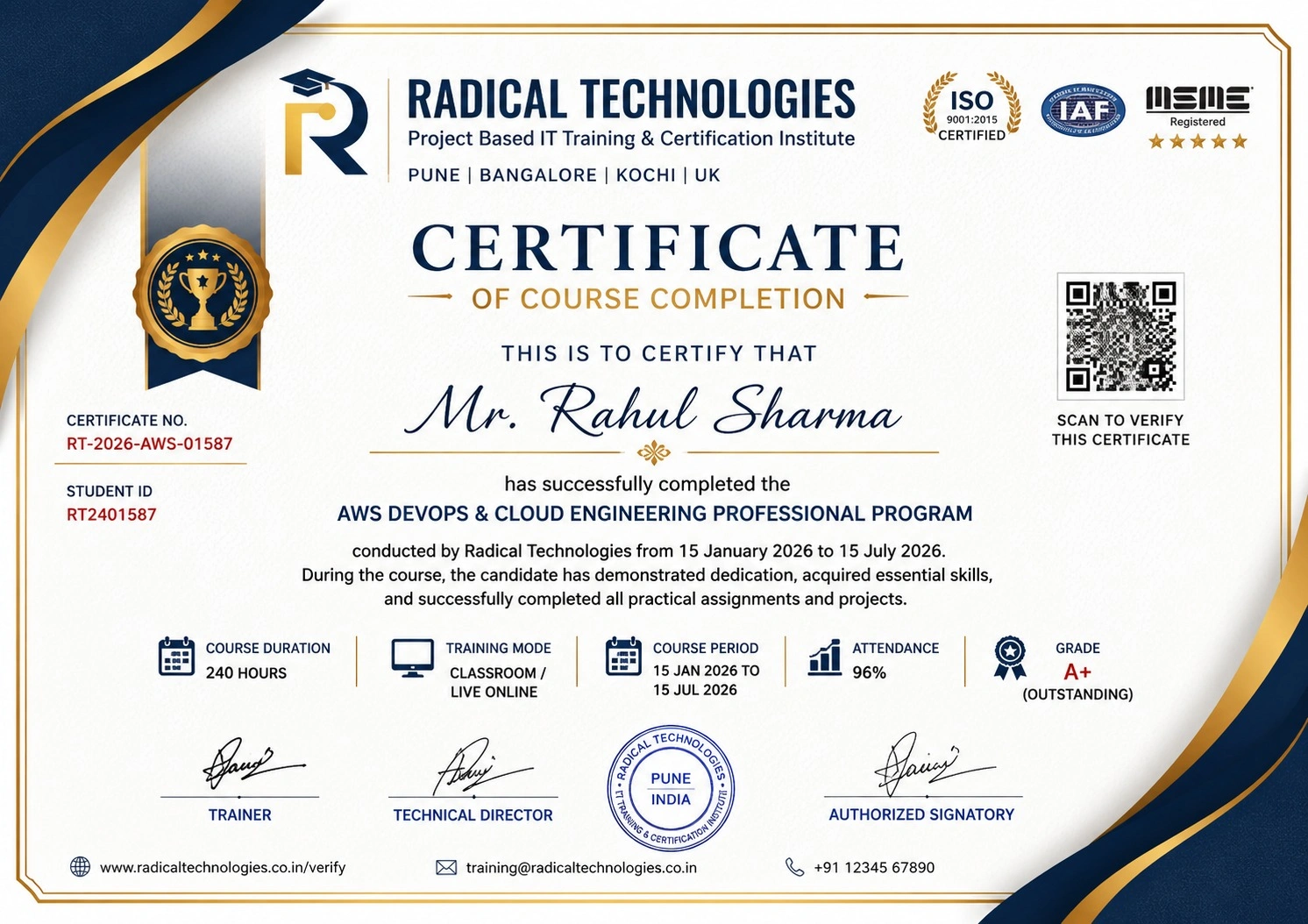
Certificate of Completion

Career Services

At Radical Technologies, we are committed to your success beyond the classroom. Our 100% Job Assistance program ensures that you are not only equipped with industry-relevant skills but also guided through the job placement process. With personalised resume building, interview preparation, and access to our extensive network of hiring partners, we help you take the next step confidently into your IT career.

Career Support

Course Completed? Need next steps?
Need Interview Supports?
Need Job Assistance?
Came from any other Institute?

Join our Brush-up Session & get support until you find a job!

Get Started

Radical Learning Eco-System

Exam Simulator

Cloud SandBox

Hands-on Cloud Lab

Developer Coding Ground

Student Reviews

4.4★
Average learner rating
50K+
Students trained
30+
Hiring companies alumni work at
100%
Placement assistance
4.4
★★★★★

Course Rating

★★★★★
62%
★★★★☆
21%
★★★☆☆
10%
★★☆☆☆
4%
★☆☆☆☆
3%

Our Alumni Work At
Accenture
Amazon
Avisys Services
Birlasoft
Capgemini
Catchpoint
Cognizant
Darwish Cybertech
DataVision
GiBots
Google
Groots Software
HCL Technologies
IBM
Info Gain
Infosys
ITCube Solutions
KPIT
L&T Infotech
Microsoft
Mphasis
mPhatek
Oracle
Quantbit Technologies
Saina Cloud
TCS
Tech Mahindra
Wipro
YASH Technologies
Zensar Technologies
Accenture
Amazon
Avisys Services
Birlasoft
Capgemini
Catchpoint
Cognizant
Darwish Cybertech
DataVision
GiBots
Google
Groots Software
HCL Technologies
IBM
Info Gain
Infosys
ITCube Solutions
KPIT
L&T Infotech
Microsoft
Mphasis
mPhatek
Oracle
Quantbit Technologies
Saina Cloud
TCS
Tech Mahindra
Wipro
YASH Technologies
Zensar Technologies