Radical Technologies
ORACLE
★★★★★
(2,095 ratings)  50,000+ Student

SQL + PLSQL

A SQL + PL/SQL combo course is a comprehensive training program that combines the fundamentals of SQL (Structured Query Language) with the advanced features of PL/SQL (Procedural Language/Structured Query Language). This course is designed to provide students with a well-rounded understanding of database management and application development using Oracle Database, as SQL and PL/SQL are commonly used in Oracle environments.

RT
Radical Technologies
50,000+ English 60 hours Weekdays / Weekends Classroom / Online / Corporate
Online / Classroom

SQL + PLSQL

IT Training Programme

Duration 60 hours
Batch Type Weekdays / Weekends
Mode of Training Classroom / Online / Corporate
Locations Pune, Bangalore, Kochi
Language English
Certification Globally Recognized
Call Now

100% placement assistance

What you'll learn

Understand core concepts and architecture from the ground up
Get hands-on with the tools used by working professionals
Build real-world projects you can add to your portfolio
Learn industry best practices and coding standards
Practice with real datasets and real-world scenarios
Prepare for certification and technical interviews
Work on collaborative, team-based exercises
Apply performance tuning and optimization techniques
Understand how the technology fits into a larger ecosystem
Complete assignments reviewed by mentors

Programme Overview

5 sections covering the complete curriculum — a single, progressive learning arc.

60 hours
Training Duration
5
Core Modules
58
Total Lessons
4.4
Average Rating
50K+
Students Trained
01

Foundations & Core Concepts

Get hands-on with the fundamentals and architecture — the building blocks for everything that follows.

Fundamentals Architecture Setup
02

Hands-On Practical Training

Work through real exercises and assignments designed to mirror what you will do on the job.

Practicals Assignments Labs
03

Real-World Projects

Apply what you have learned to end-to-end projects that go straight into your portfolio.

Projects Portfolio Case Studies
04

Advanced Techniques

Go beyond the basics with advanced concepts, integrations and production-grade practices.

Advanced Integration Best Practices
05

Ecosystem Integration

Understand how this technology connects with the broader tools and platforms used in the industry.

Ecosystem Tools Platforms
06

Performance & Interview Prep

Master optimization techniques and prepare for the technical interview questions employers actually ask.

Optimization Interview Prep Certification

Who is this programme for?

Whether you're already writing code, working with data, or supporting applications today — this programme is built to take you into a ORACLE role.

Software Developers

Engineers who want to add this skill set to their toolkit

Analysts & Consultants

Professionals moving into a more technical, hands-on role

IT Professionals

System admins and support engineers upskilling into a new domain

Fresh Graduates

CS/IT graduates aiming for a job-ready technical role

Course Curriculum

5 sections  •  58 lessons  •  60 hours

01 For whom SQL is?
IT or NON IT people can easily enter into leading Database Technology which is commonly used for all domain application software as back-end. There are so many reason to go ahead : 
Oracle SQL is basic learning platform to get in IT, which is easy to learn.
On completion Oracle SQL training you can attempt certification exam.
Certified candidate can take benefit as IT document and can get good opportunity in IT world.
Oracle SQL is easy for any support project for initial stage which get into IT carrier. In case you want to grow for development environment than it’s entry for programming.
Now a days SQL is basic skill set for any IT/NON IT folks, It’s always helpful for any functional, support and technical consultant.
02 Oracle 12c SQL Basics
WEEK-01 :
[1] Introduction to Oracle DB 12c 
Oracle Database 12c: Focus Areas, Fusion Middle-ware, Oracle Cloud, Services, Deployment Methods, RDBMS, Data Model, ER Diagram, Relation DB Terminology, SQL Statements and Development Environment, HR Schema Tables, DB Documentation. 
[2] Retrieving Data using SQL SELECT statement 
Basic Select Statement, Arithmetic Expression, Defining Null values, Concatenation Operator & Literal, Duplicate Rows, Displaying table structure. Practice Overview. 
[3] Restricting & Sorting Data 
Use of Where clause, Character Strings & Date Data, Comparison, Logical, Range, Pattern, & Other operators, Rules Precedence, Order By Clause, Substitution variables. Practice Overview 
WEEK-02 :
[4] Single Row Function & Customized Output 
SQL function, Single Row Function, Character/Case Functions, Number Functions, Nesting Function, Date Functions etc. Practice Overview. 
[5] Conversion & Conditional Expressions 
Conversion Function, Implicit/Explicit Data Conversion, General Function with covering NVL, NVL2, NULLIF, COALESCE, Conditional Expression with Decode function and Case Expression. Practice Overview. 
[6] Reporting Aggregated Data using Group Function 
Usages of Group function, Nesting Group Function, Creating Group Data, Restricting group data using Having Clause. Practice Overview. 
[7] Displaying Data from Multiple Tables using Join 
Type of Joins, Explaining with Natural Join, Using Clause, On Clause, SQL 99 Syntax, Three-Way Join, Self Join, NonEqui Join, Inner Versus Outer Join, Cross Join etc. Practice overview. 

WEEK-03 : 

[8] Using Sub-queries to solve queries 
Scenario to use Sub-query, Rules for Sub-queries, Type of Sub-queries, Single Row Sub-queries and Multi Row Sub-queries. Null value in Sub-query etc. Practice Overview.
03 Oracle 12c SQL Advanced
[9] Using Set Operator 
Set Operator Rules, Covering Set Operator as UNION, UNION ALL, INTERSECT, MINUS etc. Practice Overview. 
[10] Managing Tables using DML      Statements 
Data Manipulation Language, Covering INSERT, UPDATE, DELETE & DB Transaction control using COMMIT, ROLLBACK, SAVEPOINT. Use of For update clause in SELECT Statement. 
[11] Introduction to Data Definition Language 
Database Object, Naming Rules, Various Data Types, CREATE TABLE statement, Constraint guidelines, Defining constraints as NOT NULL, UNIQUE, PRIMARY KEY, FOREIGN KEY & CHECK etc. ALTER TABLE, DROP TABLE Statement. Create Table using Sub-query. Practice Overview. 
WEEK-04 :
[12] Introduction to Data Dictionary Views
Data Dictionary Structure, How to use Data Dictionary, USER_OBJECTS, ALL_OBJECT, USER_CONSTRAININTS. TABLE Information, Column Information etc. Practice overview.
[13] Creating Sequence, Synonyms & Indexes 
Importance of Sequence, Synonyms & Indexes. Defining Sequence, Synonyms & Indexes & DROP statement etc. Practice overview. 
[14] Creating Views
What’s View? Advantage of Views, CREATE Simple & Complex views, Rules for performing DML operation on views. Modifying & Removing a view etc. Practice Overview. 
[15] Retrieving Data by using Sub-Query 
Multiple Column Sub-query, Column Comparison, Pair & Non Pair Sub-queries, Scalar  Sub queries, Co-related Sub-queries, Use of WITH clause. Practice Overview.
04 PLSQL Basic

1] Introduction to Oracle PLSQL

Oracle PLSQL: Course Agenda, Course HR Data set, PLSQL Environment, Benefits and Block structure, Create & Execute Anonymous Block, Test output of PLSQL Block. Practice Overview.

2] Declaration PLSQL Variables

Use of Variables, Identifier, Handling Variable in PLSQL, Declaration & Initialization of PLSQL variable, Type of Variable, Guideline for Declaration & Initialization PLSQL Variables, Scalar Data Type, Bind Variables, Substitution Variables, Composite and LOB Data Type Variables. Practice Overview.

3] Writing Executable Statement

Lexical Unit of PLSQL Block, Commenting Code, Usage of SQL Function in PLSQL, Nested Block, Variable Scope & Visibility, Operator in PLSQL, Indenting PLSQL Code. Practice Overview 

WEEK-02 :

4] Interacting with Oracle Server

SQL Statement in PLSQL, Naming Convention, Manipulating Data using PLSQL, Inserting, Updating, Deleting, & Merging Data in PLSQL, SQL Cursor & Attribute. Practice Overview.

5] Writing Control Structure

Controlling Flow of Execution, IF statement, IF THEN ELSE Statement, IF ELSIF ELSE clause, NULL values in IF Statements, Case Expression, Loop statements, BASIC Loop, WHILE Loop, FOR Loop, Guidance while using loop, Nested Loop and Labels. Practice Overview.

6] Working with Composite Data Type

Composite Data Type, PLSQL Records, PLSQL Records Structure, The %ROWTYPE Attribute, Advantages of %ROWTYPE & Sample Program using Record %ROWTYPE. Practice Overview.

WEEK-03 :

7] Cursor
About Cursors, Explicit cursor operations, Curosr Life Cycle , Cursor & Records, Cursor FOR loop, Explicit Cursor Attributes, Usage of FOR UPDATE & WHERE CURRENT OF Clause, Cursor with Sub-Queries. Practice overview. 

8] Handling Exception

Handling Exception using PLSQL, Exception Types, Trapping Exceptions, Guidelines for Trapping Exception, Trapping Predefined & Non Predefined Oracle Server Errors, Function of  Trapping Exception, Propagate Exception in Sub-Block, RAISE_APPLICATION_ERROR Procedure . Practice Overview.

9] Introduction to Stored Procedure & Function

Stored Procedure & Function, Difference between Anonymous Block and Sub-programs, Procedure Syntax, Example, Execution, Function Syntax, Example, Execution, Passing Parameter to Function etc. Practice Overview.

WEEK-04 :

05 PLSQL Advanced

10] Creating Stored Procedures

Developing Procedure, What is parameters? Formal & Actual Parameters, Procedural Parameter Modes, Example of IN, OUT, INOUT parameter passing modes, Invoking Procedure, Handle Exception, Remove Procedure, Viewing Procedure in the Data Dictionary, Benefit of Subprograms, Practice Overview.

11] Creating Stored Functions

Developing Function, Way to execute Function, Advantages of User Defined Function in SQL statements, Function in SQL Expression, Location to Call User Defined Function, Restriction on Calling from SQL Expressions, Controlling side effect Calling Functions from SQL Expression, Remove Function, Viewing Function in the Data Dictionary, Procedure Versus Function. Practice Overview.

12] Introduction to Collection

Why Collection? Oracle Collection, Associative Array, Varray, Nested Table, Scenario for Collection When to use What, Ref Cursors, Type Ref Cursors, Advantage/Disadvantage of Ref Cursor. Practice overview.

WEEK-05 :

13] Creating Packages

PLSQL Package, Component of PLSQL Package, Visibility of Package Component, Developing PLSQL Package, Creating Package Specification & Package Body, Invoking Package Subprograms, Creating & Using Bodiless Package, Removing Package, Viewing Package in the Data Dictionary, Guideline to writing Package, Advantage of Using Package. Practice overview.

14] Advancement on Package Concept

Overloading Subprograms, Overloading the Standard Package, Use of Forward Declaration, Package Initialization Block, Use Package Function in SQL & Restriction, Persistent State of Package/Variables, Package using Collection, Wrapper Utility, Guideline for Wrapping. Practice Overview.

15] Design Consideration for PLSQL Code

Standardizing Constant & Exception, Exception Handling, Local Subprgrams, Definer’s Rights Versus Invoker’s Right, Features of Autonomous Transaction, Bulk Binding, Bulk Binding FORALL Example       , Using BULK COLLECT INTO with Queries/Cursors   . Practice Overview. 

WEEK-06 :

16] Creating Triggers

Type of Triggers, Guidelines of Designing Triggers, Creating DML Trigger, Type of DML Triggers, Trigger Timing, Trigger Firing Sequences, DML Statement Triggers, Using Conditional Predicates, DML ROW Trigger, Old, New Qualifier, Restricting Row Trigger, Implementing Integrity Constraint with a Trigger, Comparison of Database Triggers and Stored Procedure, Comparison of DB Trigger and Oracle Forms Triggers, Managing, Removing, Testing Trigger. Practice Overview.

17] Application for Triggers

Creating Database Triggers, Creating Triggers on DDL Statements, Creating Triggers on System Events, LOGON, LOGOFF Triggers Examples, CALL Statements, Reading Data From a Mutating Table, Benefit of DB Triggers, Business Application Scenario for Implementing Triggers, Viewing Triggers in Data Dictionary using USER_TRIGGERS. Practice Overview.

18] Project Work

It covers real time project scenario including all deliver conceptual session based on Database 10g/11g. It includes Data Import, Validation, Audit Trail, Performance based Program etc.

Tools & Technologies

Every tool listed here is installed, configured and used in a hands-on lab session.

Core Tools

Hands-On Labs

Practical Environment

Industry-Standard Tools

Real-World Setup

Guided Exercises

Skill Building

Sample Datasets

Practice Material

Practice & Projects

Mini Projects

Applied Practice

Assignments

Mentor Reviewed

Doubt Sessions

Live Support

Career Readiness

Resume Building

Career Support

Mock Interviews

Interview Prep

Certification Prep

Global Recognition

Deployment & Delivery

Production Practices

Real-World Ready

Best Practices

Industry Standards

58+
Hands-On Lessons
5
Core Modules
60 hours
Training Duration
100%
Practical Training

You don't just learn SQL + PLSQL. You ship it.

Three major projects, each mirroring how production teams actually work — from guided foundations to a portfolio-ready capstone.

PROJECT // 01

Guided Foundation Project

Requirement Analysis

Guided Implementation

Mentor Review

Iteration

Foundation Beginner

Apply the fundamentals in a structured, mentor-reviewed project

Take the core concepts from the first half of the curriculum and apply them to a realistic scenario, with guidance and feedback from your mentor at every step.

Structured project brief
Step-by-step implementation
Mentor feedback and review
Documented outcome
Stack Core Concepts Best Practices
PROJECT // 02

Applied Practice Project

Scenario Design

Independent Build

Testing & Validation

Peer Review

Applied Intermediate

Build a more independent project mirroring real production scenarios

Work through a project that combines multiple concepts from the curriculum, closer to how work is actually structured on the job — less hand-holding, more ownership.

End-to-end implementation
Testing and validation
Documentation
Peer/mentor review
Stack Applied Skills Testing
PROJECT // 03

Capstone Project

Planning

End-to-End Build

Review & Refinement

Presentation

Capstone Advanced

Take a project from requirements to a polished, portfolio-ready deliverable

Your final project — plan, build, test and present a complete solution using everything covered in the curriculum, reviewed by mentors before you graduate.

Complete working solution
Presentation-ready documentation
Mentor sign-off
Portfolio-ready deliverable
Stack Full Curriculum Portfolio

All 3 projects go directly into your portfolio & resume — reviewed by mentors before you graduate.

See Sample Project Reports

Upcoming Batches

No upcoming batches scheduled right now. Enquire to get notified.

Why Radical Technologies

Live Online Training
  • Highly practical oriented training
  • Installation support on your system
  • 24/7 Email and Phone support
  • 100% Placement Assistance
  • Global Certification Preparation
  • Trainer-Student Interactive Portal
  • Assignments and Projects by Mentors
Enroll Now
Live Classroom Training
  • Weekend / Weekdays / Morning / Evening batches
  • 80:20 Practical and Theory ratio
  • Real-life Case Studies
  • Easy make-up for missed sessions
  • PSI | Kryterion | Redhat Test Centers
  • Lifetime Video Classroom Access (coming soon)
  • Resume Prep and Mock Interviews
Enroll Now
Self-Paced Training
  • Learn 300+ courses at your own time
  • 50,000+ Satisfied Learners
  • Course Completion Certificate
  • Practical Labs available
  • Mentor Support available
  • Doubt Clearing Session available
  • 10% Discounted Global Certification
Enroll Now

Like the Curriculum? Let's Get Started

Join 50,000+ students already enrolled at Radical Technologies

Enroll Now

Global Certification

Radical Technologies is the leading IT certification institute in Pune, offering globally recognized certifications across various domains. With expert trainers and comprehensive materials, we ensure students gain in-depth knowledge and hands-on experience to excel in their careers. Our certification programs are tailored to meet industry standards — from cloud technologies to data science — empowering individuals to stay ahead in the ever-evolving tech landscape.
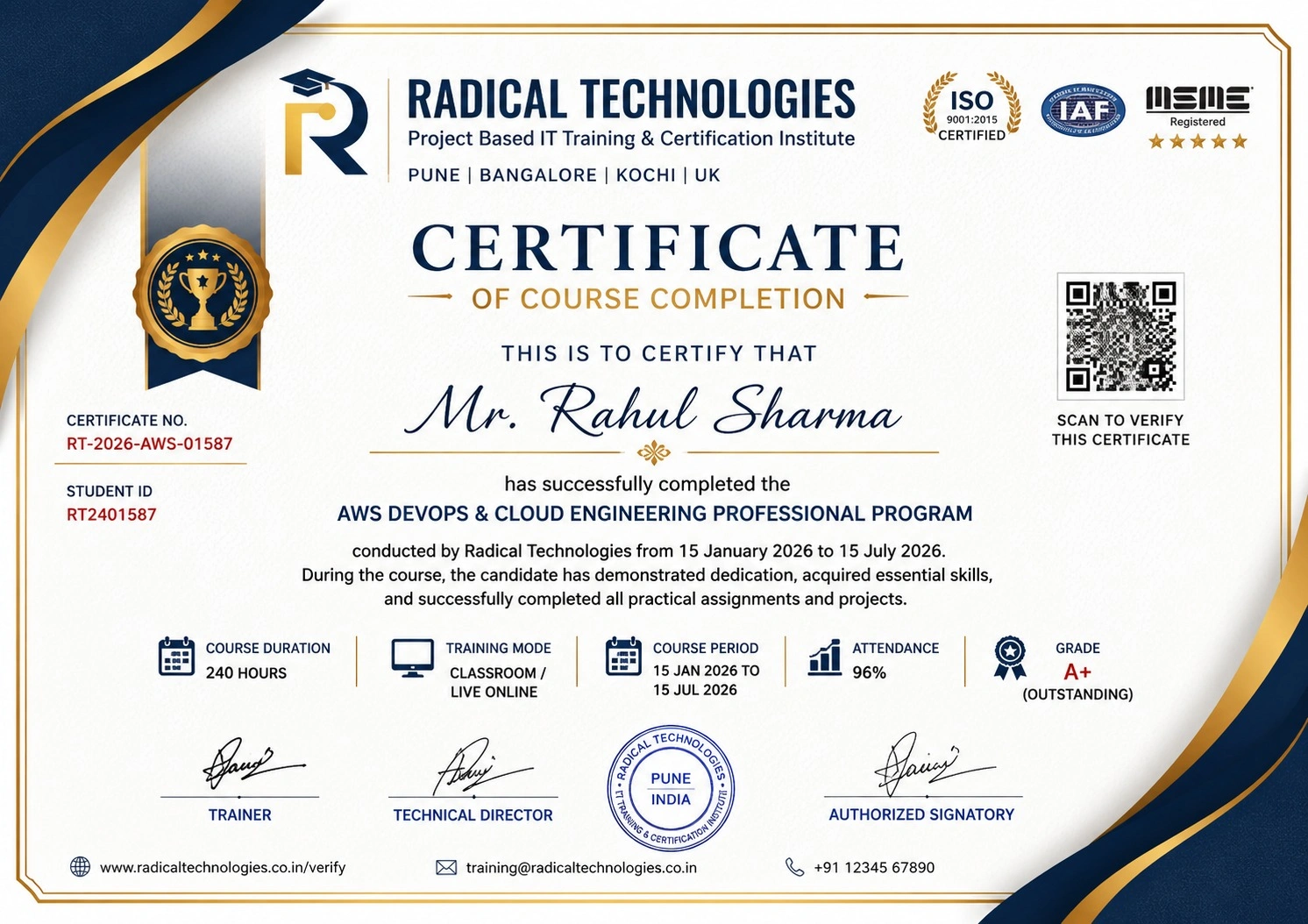
Certificate of Completion

Career Services

At Radical Technologies, we are committed to your success beyond the classroom. Our 100% Job Assistance program ensures that you are not only equipped with industry-relevant skills but also guided through the job placement process. With personalised resume building, interview preparation, and access to our extensive network of hiring partners, we help you take the next step confidently into your IT career.

Career Support

Course Completed? Need next steps?
Need Interview Supports?
Need Job Assistance?
Came from any other Institute?

Join our Brush-up Session & get support until you find a job!

Get Started

Radical Learning Eco-System

Exam Simulator

Cloud SandBox

Hands-on Cloud Lab

Developer Coding Ground

Student Reviews

4.4★
Average learner rating
50K+
Students trained
30+
Hiring companies alumni work at
100%
Placement assistance
4.4
★★★★★

Course Rating

★★★★★
62%
★★★★☆
21%
★★★☆☆
10%
★★☆☆☆
4%
★☆☆☆☆
3%

Our Alumni Work At
Accenture
Amazon
Avisys Services
Birlasoft
Capgemini
Catchpoint
Cognizant
Darwish Cybertech
DataVision
GiBots
Google
Groots Software
HCL Technologies
IBM
Info Gain
Infosys
ITCube Solutions
KPIT
L&T Infotech
Microsoft
Mphasis
mPhatek
Oracle
Quantbit Technologies
Saina Cloud
TCS
Tech Mahindra
Wipro
YASH Technologies
Zensar Technologies
Accenture
Amazon
Avisys Services
Birlasoft
Capgemini
Catchpoint
Cognizant
Darwish Cybertech
DataVision
GiBots
Google
Groots Software
HCL Technologies
IBM
Info Gain
Infosys
ITCube Solutions
KPIT
L&T Infotech
Microsoft
Mphasis
mPhatek
Oracle
Quantbit Technologies
Saina Cloud
TCS
Tech Mahindra
Wipro
YASH Technologies
Zensar Technologies