
TERRAFORM - INFRASTRUCTURE AS CODE (IAC) – MULTI CLOUD ( AWS | AZURE | GCP )
The Terraform – Infrastructure as Code (IaC) – Multi Cloud (AWS | Azure | GCP) course is designed for professionals who want to automate cloud infrastructure deployment across multiple cloud platforms using Terraform. The training covers Infrastructure as Code (IaC), Terraform configuration, modules, state management, provisioning, cloud resource automation, multi-cloud deployments, and DevOps best practices. Through hands-on labs and real-world projects, learners gain practical experience in creating, managing, and scaling infrastructure on AWS, Microsoft Azure, and Google Cloud Platform. As infrastructure automation is a core DevOps skill, this course is ideal for DevOps engineers, cloud engineers, system administrators, infrastructure professionals, platform engineers, and IT professionals looking to build expertise in multi-cloud infrastructure automation.
TERRAFORM - INFRASTRUCTURE AS CODE (IAC) – MULTI CLOUD ( AWS | AZURE | GCP )
IT Training Programme
100% placement assistance
What you'll learn
Programme Overview
15 sections covering the complete curriculum — a single, progressive learning arc.
Foundations & Core Concepts
Get hands-on with the fundamentals and architecture — the building blocks for everything that follows.
Hands-On Practical Training
Work through real exercises and assignments designed to mirror what you will do on the job.
Real-World Projects
Apply what you have learned to end-to-end projects that go straight into your portfolio.
Advanced Techniques
Go beyond the basics with advanced concepts, integrations and production-grade practices.
Ecosystem Integration
Understand how this technology connects with the broader tools and platforms used in the industry.
Performance & Interview Prep
Master optimization techniques and prepare for the technical interview questions employers actually ask.
Who is this programme for?
Whether you're already writing code, working with data, or supporting applications today — this programme is built to take you into a CLOUD COMPUTING - AZURE role.
Software Developers
Engineers who want to add this skill set to their toolkit
Analysts & Consultants
Professionals moving into a more technical, hands-on role
IT Professionals
System admins and support engineers upskilling into a new domain
Fresh Graduates
CS/IT graduates aiming for a job-ready technical role
Course Curriculum
15 sections • 113 lessons • 40 hours
Jump to Section
Total Duration
40 hours
100% Practical · Unlimited Doubt Sessions
01 🔷 PHASE 1: Fundamentals
📘 Topic: Introduction to IaC
🔹 What is taught:
📚 Subtopics (Detailed):
Imperative vs Declarative:
Idempotency:
Drift Detection:
🛠 Practical:
02 🔷 PHASE 2: Terraform Core Concepts
📘 Topic: Terraform Architecture
🔹 What is taught:
📚 Subtopics (Detailed):
Providers:
Resources:
Variables & Outputs:
Lifecycle Commands:
🛠 Lab:
03 🔷 PHASE 3: Terraform State Management
📘 Topic: State File Management
🔹 What is taught:
📚 Subtopics (Detailed):
Local vs Remote State:
Backend Configuration:
State Locking:
🛠 Assignment:
- ›Configure remote backend
- ›Simulate state drift and fix it
04 🔷 PHASE 4: Terraform Modules
📘 Topic: Modular Infrastructure
🔹 What is taught:
📚 Subtopics (Detailed):
Reusable Modules:
Input/Output Variables:
Module Versioning:
🛠 Assignment:
- ›Build reusable VPC module
- ›Use module across dev/prod environments
05 🔷 PHASE 5: Terraform for AWS
📘 Topic: AWS Infrastructure Provisioning
🔹 What is taught:
📚 Subtopics (Detailed):
VPC & Networking:
Compute (EC2):
Security Groups:
IAM:
🛠 Lab:
06 🔷 PHASE 6: Terraform for Azure
📘 Topic: Azure Infrastructure Provisioning
🔹 What is taught:
📚 Subtopics (Detailed):
Resource Groups:
Virtual Network (VNet):
Virtual Machines:
🛠 Lab:
07 🔷 PHASE 7: Terraform for GCP
📘 Topic: GCP Infrastructure Provisioning
🔹 What is taught:
📚 Subtopics (Detailed):
Compute Engine:
IAM:
🛠 Lab:
08 🔷 PHASE 8: Multi-Cloud Architecture
📘 Topic: Multi-Cloud Design
🔹 What is taught:
📚 Subtopics (Detailed):
Multi-Provider Configuration:
Environment Separation:
Standardization:
🛠 Assignment:
- ›Deploy same app across all three clouds
09 🔷 PHASE 9: Advanced Terraform
📘 Topic: Advanced Coding Techniques
🔹 What is taught:
📚 Subtopics (Detailed):
Dynamic Blocks:
Conditionals:
Provisioners:
🛠 Assignment:
- ›Automate complex infrastructure
10 🔷 PHASE 10: CI/CD Integration
📘 Topic: Infrastructure Pipelines
🔹 What is taught:
📚 Subtopics (Detailed):
Git Integration:
Pipeline Stages:
🛠 Lab:
11 🔷 PHASE 11: Security & Best Practices
📘 Topic: Terraform Security
🔹 What is taught:
📚 Subtopics (Detailed):
Secrets Management:
IAM Best Practices:
State Security:
12 🔷 PHASE 12: Monitoring & Cost Optimization
📘 Topic: Cost & Performance
🔹 What is taught:
📚 Subtopics (Detailed):
Resource Tagging:
Cost Estimation:
Optimization:
13 🔷 🚀 Capstone Projects
14 🔷 🏢 Real Job Scenarios
15 🔥 Final Outcome
Tools & Technologies
Every tool listed here is installed, configured and used in a hands-on lab session.
Hands-On Labs
Practical Environment
Industry-Standard Tools
Real-World Setup
Guided Exercises
Skill Building
Sample Datasets
Practice Material
Mini Projects
Applied Practice
Assignments
Mentor Reviewed
Doubt Sessions
Live Support
Resume Building
Career Support
Mock Interviews
Interview Prep
Certification Prep
Global Recognition
Production Practices
Real-World Ready
Best Practices
Industry Standards
You don't just learn TERRAFORM - INFRASTRUCTURE AS CODE (IAC) – MULTI CLOUD ( AWS | AZURE | GCP ). You ship it.
Three major projects, each mirroring how production teams actually work — from guided foundations to a portfolio-ready capstone.
Guided Foundation Project
→Requirement Analysis
→Guided Implementation
→Mentor Review
→Iteration
Apply the fundamentals in a structured, mentor-reviewed project
Take the core concepts from the first half of the curriculum and apply them to a realistic scenario, with guidance and feedback from your mentor at every step.
Applied Practice Project
→Scenario Design
→Independent Build
→Testing & Validation
→Peer Review
Build a more independent project mirroring real production scenarios
Work through a project that combines multiple concepts from the curriculum, closer to how work is actually structured on the job — less hand-holding, more ownership.
Capstone Project
→Planning
→End-to-End Build
→Review & Refinement
→Presentation
Take a project from requirements to a polished, portfolio-ready deliverable
Your final project — plan, build, test and present a complete solution using everything covered in the curriculum, reviewed by mentors before you graduate.
All 3 projects go directly into your portfolio & resume — reviewed by mentors before you graduate.
See Sample Project ReportsUpcoming Batches
Why Radical Technologies
- Highly practical oriented training
- Installation support on your system
- 24/7 Email and Phone support
- 100% Placement Assistance
- Global Certification Preparation
- Trainer-Student Interactive Portal
- Assignments and Projects by Mentors
- Weekend / Weekdays / Morning / Evening batches
- 80:20 Practical and Theory ratio
- Real-life Case Studies
- Easy make-up for missed sessions
- PSI | Kryterion | Redhat Test Centers
- Lifetime Video Classroom Access (coming soon)
- Resume Prep and Mock Interviews
- Learn 300+ courses at your own time
- 50,000+ Satisfied Learners
- Course Completion Certificate
- Practical Labs available
- Mentor Support available
- Doubt Clearing Session available
- 10% Discounted Global Certification
Like the Curriculum? Let's Get Started
Join 50,000+ students already enrolled at Radical Technologies
Global Certification
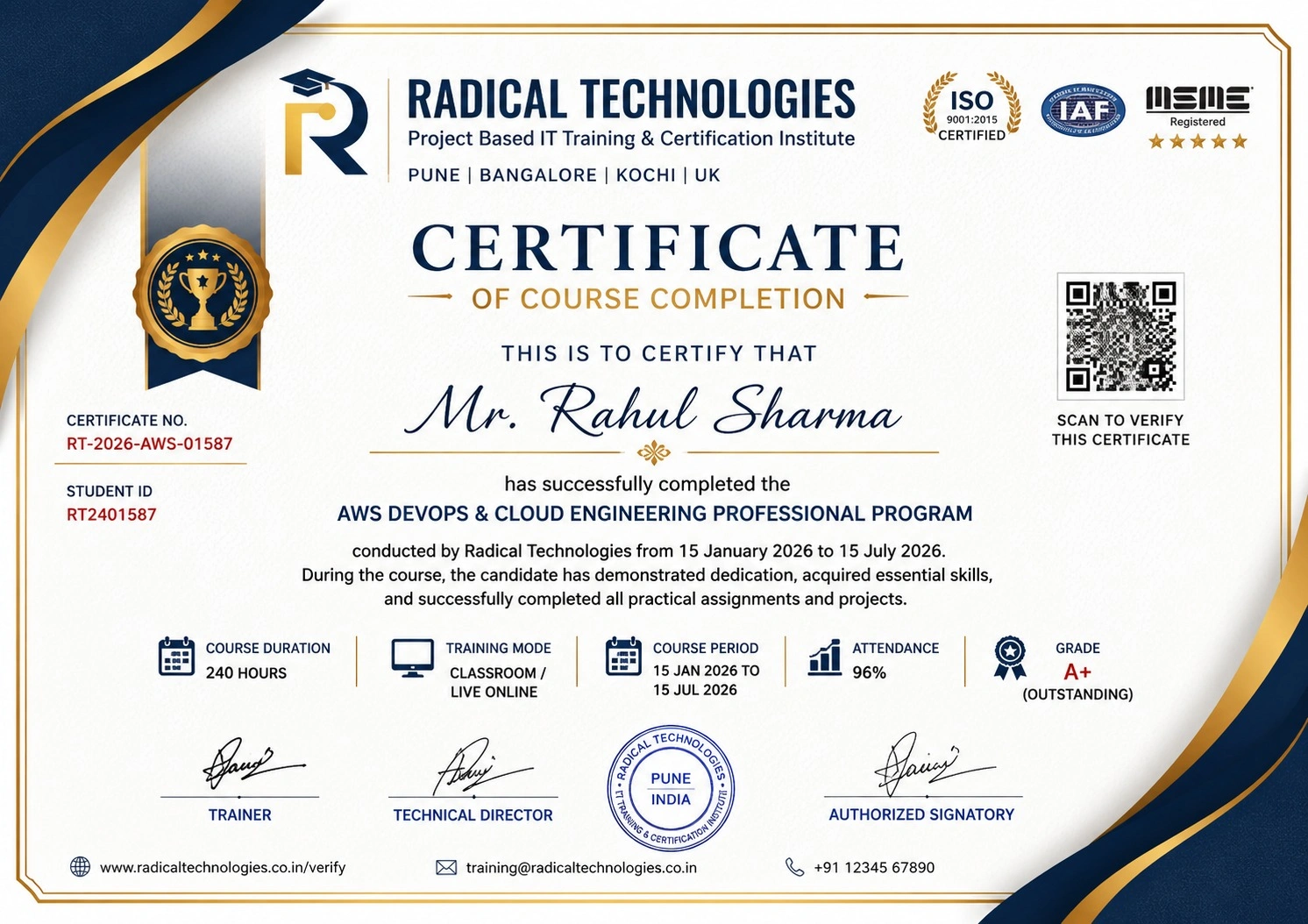
Radical Technologies is the leading IT certification institute in Pune, offering globally recognized certifications across various domains. With expert trainers and comprehensive materials, we ensure students gain in-depth knowledge and hands-on experience to excel in their careers. Our certification programs are tailored to meet industry standards — from cloud technologies to data science — empowering individuals to stay ahead in the ever-evolving tech landscape.
Career Services
At Radical Technologies, we are committed to your success beyond the classroom. Our 100% Job Assistance program ensures that you are not only equipped with industry-relevant skills but also guided through the job placement process. With personalised resume building, interview preparation, and access to our extensive network of hiring partners, we help you take the next step confidently into your IT career.
Career Support
Join our Brush-up Session & get support until you find a job!
Get StartedRadical Learning Eco-System
Exam Simulator
Cloud SandBox
Hands-on Cloud Lab
Developer Coding Ground
Student Reviews
Course Rating
Our Alumni Work At






Related Courses
TERRAFORM - INFRASTRUCTURE AS CODE (IAC) – MULTI CLOUD ( AWS | AZURE | GCP ) Course In Other Cities
Online Batches Available For These Areas
Ambegaon Budruk | Aundh | Baner | Bavdhan Khurd | Bavdhan Budruk | Balewadi | Shivajinagar | Bibvewadi | Bhugaon | Bhukum | Dhankawadi | Dhanori | Dhayari | Erandwane | Fursungi | Ghorpadi | Hadapsar | Hingne Khurd | Karve Nagar | Kalas | Katraj | Khadki | Kharadi | Kondhwa | Koregaon Park | Kothrud | Lohagaon | Manjri | Markal | Mohammed Wadi | Mundhwa | Nanded | Parvati Hill | Panmala | Pashan | Pirangut | Shivane | Sus | Undri | Vishrantwadi | Vitthalwadi | Vadgaon Khurd | Vadgaon Budruk | Vadgaon Sheri | Wagholi | Wanwadi | Warje | Yerwada | Akurdi | Bhosari | Chakan | Charholi Budruk | Chikhli | Chimbali | Chinchwad | Dapodi | Dehu Road | Dighi | Dudulgaon | Hinjawadi | Kalewadi | Kasarwadi | Maan | Moshi | Phugewadi | Pimple Gurav | Pimple Nilakh | Pimple Saudagar | Pimpri | Ravet | Rahatani | Sangvi | Talawade | Tathawade | Thergaon | Wakad
TERRAFORM - INFRASTRUCTURE AS CODE (IAC) – MULTI CLOUD ( AWS | AZURE | GCP )
IT Training Programme
100% placement assistance