
VLSI DESIGN AND FUNCTIONAL VERIFICATION
VLSI Design & Functional Verification training helps learners understand how digital chips are designed and tested for real-world applications. The course covers Digital Electronics, Verilog HDL, RTL Design, SystemVerilog, Functional Verification, and UVM. Through hands-on practice, debugging exercises, and projects, learners develop practical skills for the semiconductor industry and prepare for roles such as RTL Design Engineer, ASIC Design Engineer, and Design Verification Engineer.
VLSI DESIGN AND FUNCTIONAL VERIFICATION
IT Training Programme
100% placement assistance
What you'll learn
Programme Overview
14 sections covering the complete curriculum — a single, progressive learning arc.
Foundations & Core Concepts
Get hands-on with the fundamentals and architecture — the building blocks for everything that follows.
Hands-On Practical Training
Work through real exercises and assignments designed to mirror what you will do on the job.
Real-World Projects
Apply what you have learned to end-to-end projects that go straight into your portfolio.
Advanced Techniques
Go beyond the basics with advanced concepts, integrations and production-grade practices.
Ecosystem Integration
Understand how this technology connects with the broader tools and platforms used in the industry.
Performance & Interview Prep
Master optimization techniques and prepare for the technical interview questions employers actually ask.
Who is this programme for?
Whether you're already writing code, working with data, or supporting applications today — this programme is built to take you into a OTHER role.
Software Developers
Engineers who want to add this skill set to their toolkit
Analysts & Consultants
Professionals moving into a more technical, hands-on role
IT Professionals
System admins and support engineers upskilling into a new domain
Fresh Graduates
CS/IT graduates aiming for a job-ready technical role
Course Curriculum
14 sections • 236 lessons • 6 Months
Jump to Section
Total Duration
6 Months
100% Practical · Unlimited Doubt Sessions
01 Course Overview
This program is designed to build skills in digital hardware design and functional verification for the semiconductor industry. Students progress from digital logic fundamentals to RTL coding, SystemVerilog testbench development, and UVM-based verification.
The program combines theory, hands-on EDA tool usage, debugging exercises, design assignments, verification projects, and job-oriented scenarios relevant to ASIC, SoC, and FPGA development.
Primary career tracks:
02 Prerequisites
03 Fundamentals
04 Core Technical Topics — Main Syllabus
Module 1: Digital Electronics and Logic Design
30 hours
Module 2: Verilog HDL Programming
40 hours
Module 3: RTL Design and Synthesis Fundamentals
45 hours
Module 4: SystemVerilog for Design and Verification
45 hours
Module 5: Functional Verification and Verification Planning
30 hours
Module 6: UVM-Based Functional Verification
50 hours
Module 7: Advanced Verification and Industry Workflow
30 hours
Module 8: Integration, Projects, and Interview Preparation
30 hours
Duration note: The module allocations above total 300 hours. Allow an additional 30–60 hours for extended labs, independent practice, or deeper project work to reach the recommended 300–360-hour delivery range.
05 Hands-On Labs
The following labs should be completed progressively, with simulation results and source code retained for review.
Lab Hands-on exercise
- ›Logic Gates and Truth-Table Verification
- ›Boolean Expression Simplification Using K-Maps
- ›Half Adder, Full Adder, and Subtractor Design
- ›Multiplexer, Decoder, and Encoder Implementation
- ›Flip-Flops, Registers, and Shift Registers
- ›Synchronous and Asynchronous Counter Design
- ›Moore and Mealy FSM Implementation
- ›Verilog Combinational and Sequential Coding
- ›Verilog Testbench and Waveform Debugging
- ›Parameterized ALU RTL Design
- ›FIFO RTL Design and Pointer Management
- ›Synthesizable RTL and Latch-Inference Analysis
- ›RTL Synthesis and Netlist Inspection
- ›Timing Constraints and Critical-Path Analysis
- ›SystemVerilog Arrays, Structures, and Packages
- ›SystemVerilog OOP and Transaction Classes
- ›Constrained-Random Stimulus Generation
- ›Functional Coverage and Coverage Crosses
- ›Assertions for Counters, FIFOs, and FSMs
- ›Self-Checking Testbench and Scoreboard Creation
- ›UVM Sequence Item, Sequence, and Sequencer
- ›UVM Driver and Monitor Implementation
- ›UVM Agent and Environment Construction
- ›UVM Scoreboard and Analysis-Port Integration
- ›UVM Factory and Configuration Database
- ›UVM Phases, Objections, and Test Execution
- ›UVM Constrained-Random Regression
- ›APB Protocol Verification
- ›Coverage Closure and Regression Failure Triage
- ›Capstone Integration, Verification, and Final Report
06 Assignments
Students should complete these assignments individually and submit code, test results, and brief technical documentation.
- ›Convert decimal values to binary, hexadecimal, and signed representations.
- ›Simplify Boolean expressions and implement optimized logic.
- ›Design and verify a 4-bit ALU using Verilog.
- ›Implement a parameterized up/down counter with reset and enable.
- ›Develop an FSM-based traffic light controller.
- ›Write a self-checking testbench for a register bank.
- ›Implement a synchronous FIFO with full and empty flags.
- ›Identify and fix inferred latches in RTL code.
- ›Compare blocking and nonblocking assignment behavior.
- ›Analyze setup and hold timing violations in sample timing reports.
- ›Create SystemVerilog classes for packet and transaction generation.
- ›Write constrained-random stimulus for a FIFO.
- ›Build functional coverage for an ALU operation set.
- ›Write assertions to check FSM transitions and FIFO behavior.
- ›Develop a scoreboard for a memory or register interface.
- ›Create a reusable UVM agent with driver, monitor, and sequencer.
- ›Implement a UVM test using configuration settings and factory overrides.
- ›Develop an APB transaction sequence and protocol checks.
- ›Debug a failing constrained-random regression and document the root cause.
- ›Prepare a coverage summary and verification sign-off report for a design block.
07 Mini Projects
Project 1:
Implement arithmetic and logical operations, status flags, and a self-checking Verilog testbench. Verify corner cases such as overflow and zero results.
Skills:
Project 2:
Design a parameterized FSM with timer-based transitions, reset handling, and pedestrian request support. Validate state transitions using assertions.
Skills:
Project 3:
Develop a configurable-depth FIFO with read/write controls, occupancy tracking, full/empty flags, and reset behavior. Verify simultaneous reads and writes.
Skills:
Project 4:
Create transaction classes, randomized stimulus, constraints, functional coverage, and assertions for an ALU or FIFO.
Skills:
Project 5:
Build a reusable UVM agent with transaction sequences, driver, monitor, analysis connections, and a scoreboard. Run directed and randomized tests.
Skills:
08 Capstone Projects
These are larger projects suitable for a portfolio and technical interviews.
Capstone 1: RTL Design and Verification of a Synchronous FIFO
Capstone 2: UVM-Based APB Peripheral Verification
Capstone 3: Mini-SoC Integration and Verification
Expected deliverables: RTL source code, testbench/UVM environment, test plan, test results, waveform evidence, assertions, coverage reports, bug logs, and project documentation.
09 Real-Time Job-Oriented Scenarios
Job scenario - Practical task
- ›RTL development – Implement a register bank based on a design specification.
- ›Design optimization – Reduce unnecessary logic while preserving functional behavior.
- ›FSM debugging – Fix invalid state transitions or incomplete reset behavior.
- ›FIFO verification – Detect data loss, duplication, or incorrect full/empty flags.
- ›Timing investigation – Analyze a critical path and identify potential timing bottlenecks.
- ›Reset verification – Validate reset assertion, release, and initialization behavior.
- ›Randomized testing – Reproduce intermittent failures using a recorded random seed.
- ›Assertion-based verification – Detect illegal protocol transitions using SVA.
- ›UVM development – Add a new sequence and test to an existing verification environment.
- ›Scoreboard debugging – Identify mismatches between expected and observed transactions.
- ›Protocol verification – Verify APB transfers, wait states, and error responses.
- ›Regression management – Triage failures across multiple tests and identify common root causes.
- ›Coverage closure – Identify untested functional scenarios and add targeted tests.
- ›Design integration – Verify register maps, interfaces, and module interactions.
10 Troubleshooting Scenarios
11 Industry Tools
The syllabus should include practical exposure to industry EDA tools. Access to commercial tools depends on institutional licenses; open-source tools can support many foundational labs.
Recommended tool strategy: Start with Icarus Verilog and GTKWave for foundational HDL labs, use a SystemVerilog-capable simulator for advanced verification, and use a licensed commercial simulator for UVM labs when available. Tool support for SystemVerilog and UVM varies by version.
12 Certification Names
There is no single universally required certification covering the entire Verilog-to-UVM pathway. Students can pursue relevant vendor certifications and training credentials alongside practical projects.
For this syllabus, vendor-specific SystemVerilog, UVM, and RTL design training certificates are the most directly aligned options. Verify current course availability and whether a credential is a completion certificate or a formal certification before advertising it.
13 Mock Interviews
Conduct role-specific mock interviews with coding and debugging rounds.
14 Recommended Learning Roadmap
M1
M2
M3
M4
M5
M6
Tools & Technologies
Every tool listed here is installed, configured and used in a hands-on lab session.
Hands-On Labs
Practical Environment
Industry-Standard Tools
Real-World Setup
Guided Exercises
Skill Building
Sample Datasets
Practice Material
Mini Projects
Applied Practice
Assignments
Mentor Reviewed
Doubt Sessions
Live Support
Resume Building
Career Support
Mock Interviews
Interview Prep
Certification Prep
Global Recognition
Production Practices
Real-World Ready
Best Practices
Industry Standards
You don't just learn VLSI DESIGN AND FUNCTIONAL VERIFICATION. You ship it.
Three major projects, each mirroring how production teams actually work — from guided foundations to a portfolio-ready capstone.
Guided Foundation Project
→Requirement Analysis
→Guided Implementation
→Mentor Review
→Iteration
Apply the fundamentals in a structured, mentor-reviewed project
Take the core concepts from the first half of the curriculum and apply them to a realistic scenario, with guidance and feedback from your mentor at every step.
Applied Practice Project
→Scenario Design
→Independent Build
→Testing & Validation
→Peer Review
Build a more independent project mirroring real production scenarios
Work through a project that combines multiple concepts from the curriculum, closer to how work is actually structured on the job — less hand-holding, more ownership.
Capstone Project
→Planning
→End-to-End Build
→Review & Refinement
→Presentation
Take a project from requirements to a polished, portfolio-ready deliverable
Your final project — plan, build, test and present a complete solution using everything covered in the curriculum, reviewed by mentors before you graduate.
All 3 projects go directly into your portfolio & resume — reviewed by mentors before you graduate.
See Sample Project ReportsUpcoming Batches
Why Radical Technologies
- Highly practical oriented training
- Installation support on your system
- 24/7 Email and Phone support
- 100% Placement Assistance
- Global Certification Preparation
- Trainer-Student Interactive Portal
- Assignments and Projects by Mentors
- Weekend / Weekdays / Morning / Evening batches
- 80:20 Practical and Theory ratio
- Real-life Case Studies
- Easy make-up for missed sessions
- PSI | Kryterion | Redhat Test Centers
- Lifetime Video Classroom Access (coming soon)
- Resume Prep and Mock Interviews
- Learn 300+ courses at your own time
- 50,000+ Satisfied Learners
- Course Completion Certificate
- Practical Labs available
- Mentor Support available
- Doubt Clearing Session available
- 10% Discounted Global Certification
Like the Curriculum? Let's Get Started
Join 50,000+ students already enrolled at Radical Technologies
Global Certification
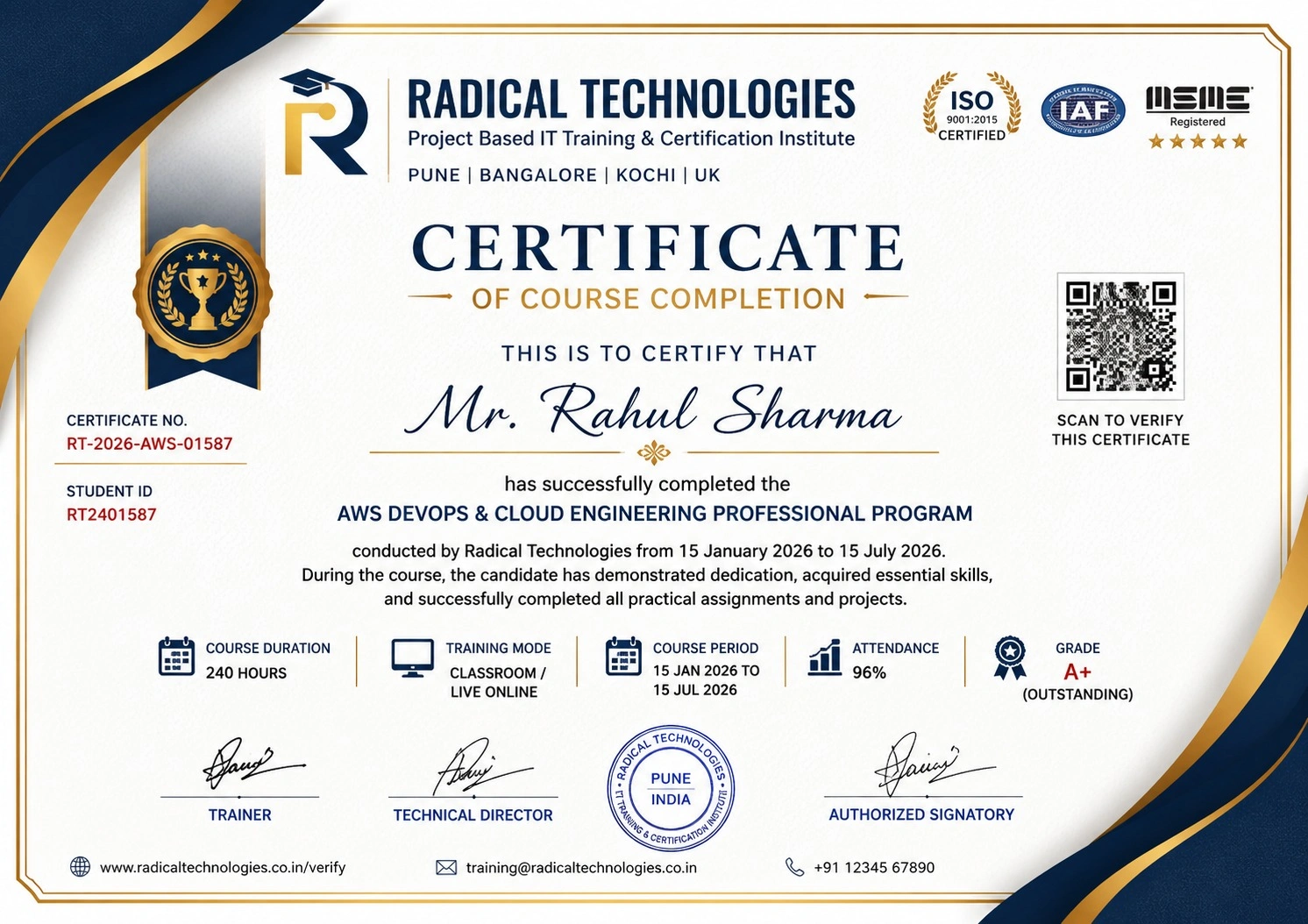
Radical Technologies is the leading IT certification institute in Pune, offering globally recognized certifications across various domains. With expert trainers and comprehensive materials, we ensure students gain in-depth knowledge and hands-on experience to excel in their careers. Our certification programs are tailored to meet industry standards — from cloud technologies to data science — empowering individuals to stay ahead in the ever-evolving tech landscape.
Career Services
At Radical Technologies, we are committed to your success beyond the classroom. Our 100% Job Assistance program ensures that you are not only equipped with industry-relevant skills but also guided through the job placement process. With personalised resume building, interview preparation, and access to our extensive network of hiring partners, we help you take the next step confidently into your IT career.
Career Support
Join our Brush-up Session & get support until you find a job!
Get StartedRadical Learning Eco-System
Exam Simulator
Cloud SandBox
Hands-on Cloud Lab
Developer Coding Ground
Student Reviews
Course Rating






Our Alumni Work At


























Related Courses


VLSI DESIGN AND FUNCTIONAL VERIFICATION Course In Other Cities
Online Batches Available For These Areas
Ambegaon Budruk | Aundh | Baner | Bavdhan Khurd | Bavdhan Budruk | Balewadi | Shivajinagar | Bibvewadi | Bhugaon | Bhukum | Dhankawadi | Dhanori | Dhayari | Erandwane | Fursungi | Ghorpadi | Hadapsar | Hingne Khurd | Karve Nagar | Kalas | Katraj | Khadki | Kharadi | Kondhwa | Koregaon Park | Kothrud | Lohagaon | Manjri | Markal | Mohammed Wadi | Mundhwa | Nanded | Parvati Hill | Panmala | Pashan | Pirangut | Shivane | Sus | Undri | Vishrantwadi | Vitthalwadi | Vadgaon Khurd | Vadgaon Budruk | Vadgaon Sheri | Wagholi | Wanwadi | Warje | Yerwada | Akurdi | Bhosari | Chakan | Charholi Budruk | Chikhli | Chimbali | Chinchwad | Dapodi | Dehu Road | Dighi | Dudulgaon | Hinjawadi | Kalewadi | Kasarwadi | Maan | Moshi | Phugewadi | Pimple Gurav | Pimple Nilakh | Pimple Saudagar | Pimpri | Ravet | Rahatani | Sangvi | Talawade | Tathawade | Thergaon | Wakad
VLSI DESIGN AND FUNCTIONAL VERIFICATION
IT Training Programme
100% placement assistance