Radical Technologies
ORACLE
★★★★★
(2,095 ratings)  50,000+ Student

ORACLE FINANCIAL

Oracle Financials is a comprehensive suite of financial management software applications offered by Oracle Corporation. It is designed to help organizations efficiently manage their financial operations, streamline processes, enhance financial reporting and analysis, and ensure compliance with regulatory requirements. Its flexibility and integration capabilities make it a popular choice for enterprises looking to optimize their financial operations.

RT
Radical Technologies
50,000+ English 60 hours Weekdays / Weekends Classroom / Online / Corporate
Online / Classroom

ORACLE FINANCIAL

IT Training Programme

Duration 60 hours
Batch Type Weekdays / Weekends
Mode of Training Classroom / Online / Corporate
Locations Pune, Bangalore, Kochi
Language English
Certification Globally Recognized
Call Now

100% placement assistance

What you'll learn

Understand core concepts and architecture from the ground up
Get hands-on with the tools used by working professionals
Build real-world projects you can add to your portfolio
Learn industry best practices and coding standards
Practice with real datasets and real-world scenarios
Prepare for certification and technical interviews
Work on collaborative, team-based exercises
Apply performance tuning and optimization techniques
Understand how the technology fits into a larger ecosystem
Complete assignments reviewed by mentors

Programme Overview

6 sections covering the complete curriculum — a single, progressive learning arc.

60 hours
Training Duration
6
Core Modules
263
Total Lessons
4.4
Average Rating
50K+
Students Trained
01

Foundations & Core Concepts

Get hands-on with the fundamentals and architecture — the building blocks for everything that follows.

Fundamentals Architecture Setup
02

Hands-On Practical Training

Work through real exercises and assignments designed to mirror what you will do on the job.

Practicals Assignments Labs
03

Real-World Projects

Apply what you have learned to end-to-end projects that go straight into your portfolio.

Projects Portfolio Case Studies
04

Advanced Techniques

Go beyond the basics with advanced concepts, integrations and production-grade practices.

Advanced Integration Best Practices
05

Ecosystem Integration

Understand how this technology connects with the broader tools and platforms used in the industry.

Ecosystem Tools Platforms
06

Performance & Interview Prep

Master optimization techniques and prepare for the technical interview questions employers actually ask.

Optimization Interview Prep Certification

Who is this programme for?

Whether you're already writing code, working with data, or supporting applications today — this programme is built to take you into a ORACLE role.

Software Developers

Engineers who want to add this skill set to their toolkit

Analysts & Consultants

Professionals moving into a more technical, hands-on role

IT Professionals

System admins and support engineers upskilling into a new domain

Fresh Graduates

CS/IT graduates aiming for a job-ready technical role

Course Curriculum

6 sections  •  263 lessons  •  60 hours

01 R12.x Oracle E-Business Suite Essentials for Implementer [3 Days]
E-BUSINESS ESSENTIALS 
Navigating in R12 Oracle Applications
Log in to Oracle Applications
Navigate from Personal Home Page to Applications
Choose a responsibility
Create Favorites and set Preferences
Use Forms and Menus
Enter data using Forms
Search for data using Forms
Access online Help
Run and monitor Reports and Programs
Log out of Oracle Applications
Introduction to Oracle Applications R12
Explain the footprint of R12 E-Business Suite
Describe the benefits of R12 E-Business Suite
Describe R12 E-Business Suite architecture
Shared Entities and Integration
Explain shared entities within R12 E-Business Suite
Describe key integration points and business flows between products in E-Business Suite (EBS)
Identify Key Business Flows and products involved in E-Business Suite (EBS)
Fundamentals of Flexfields
Describe Flexfields and their components
Identify the steps to implement a Flexfield
Define value sets and values
Define Key Flexfields
Define Descriptive Flexfields
Fundamentals of Multi-Org
Define Multiple Organization (Multi-Org)
Describe the types of organizations supported in the Multi-Org model
Explain the entities of Multi-Org
Explain how Multi-Org secures data
Identify key implementation considerations for Multi-Org
Define Multi-Org Access Control
Explain Multi-Org preferences
Explain Enhanced Multiple-Organization Reporting
Explain the concepts of subledger accounting
Fundamentals of Workflow and Alerts
Explain Workflow concepts
Describe the benefits of Workflow
02 GENERAL LEDGER [5 Days]

Oracle General Ledger Process

Identify the steps required to complete the accounting cycle using Oracle General Ledger
Describe how Oracle General Ledger integrates with other Oracle eBusiness applications
Describe the integration of Oracle General Ledger with Oracle Subledgers & non-Oracle systems
Explain implementation considerations for setting up and using Oracle General Ledger and Oracle eBusiness Suite
Describe an overview of Accounting Setup Manager, currency concepts, budgeting, EPB, reporting & analysis

Basic Journal Entries

Describe how journal entries are positioned in the accounting cycle
Describe the different Journal Posting options
Define how to perform Account Inquiries & Drilldown to Oracle Subledger Applications
Import journal entry information using the GL_INTERFACE table
Plan the key elements of Web Applications Desktop Integrator (Web ADI)
Define Web ADI setup options for key flexfields
Utilize Web ADI profile options, forms functions, menus, and responsibilities

Advanced Security

Manage Data Access Security for Legal Entities and Ledgers
Explain key Advanced Security setups and process
Manage Data Access Sets
Control security of Management Reporting

Multi-Currency

Explain Multi-Currency concepts
Use Currency Rate Manager
Perform Foreign currency journals Entry
Perform Revaluation of foreign currency balances
Translate functional balances into foreign currency
Describe overview of Secondary Tracking Segment
Use Foreign Currency Reports

Financial Reporting

Explain the positioning of Financial Reporting within the Oracle General Ledger business flow
Build basic reports
Use key elements of the Financial Statement Generator (FSG) for creating financial reports
Use Standard listing reports available for FSG report definitions
Create FSG Reports with XML Publisher
Use Web ADI for Financial Reporting
Explain key implementation issues regarding Oracle General Ledger financial reporting

Accounting Setup Manager

Describe the components of Ledger Processing options
Describe Secondary Ledgers & Reporting Currencies
Describe Accounting Setup considerations with one legal entity
Describe Accounting Setup considerations with multiple legal entities
Describe Accounting Setup considerations with no legal entities

Accounting Setups

Create Accounting Setups
Describe the various Subledger Accounting Options
Perform the Primary Ledger Setup steps
Describe Ledger Balancing Segment Value Assignments
Perform the Secondary Ledger Setup steps
Complete Accounting Setup

Advanced Journal Entries

Create Recurring Journals
Formulate Mass Allocation Journals
Describe AutoAllocations and related implementation considerations
Explain AutoScheduling
Describe the Journal Scheduling process
Describe key issues and considerations when implementing Advanced Journal Entry
Describe the business benefits of using Oracle General Ledger’s Advanced Journal Entry functions

Consolidations

Explain overview of Consolidations and their positioning within the Oracle General Ledger business flow
Identify the key implementation issues regarding consolidations
Use the features and functionality of Global Consolidation System (GCS)
Use the elements of the Consolidation Workbench
Create eliminating entries
Use Standard reports and inquiry options available for consolidations Ledger
Describe the elements required to create a ledger within Oracle General Ledger
Describe the basic components of Accounting Setup
Describe the important elements for creating a Chart of Accounts structure
Creating a new Accounting Flexfield structure
Utilize the Account Hierarchy Manager to view and maintain Accounting Flexfield values

Summary Accounts

Explain summary accounts and how they are used in General Ledger
Define How Parent Values/ Rollup Groups are used in General Ledger
Determine how Summary Templates are used
Use Budgetary Control & maintain Summary accounts
Plan and maintain Summary Account structures

Financial Budgeting

Explain the anatomy of a budget
Explain the components of budget accounting cycle
Define budget and budget organization
Explain Budget Entry methods
Apply Budget Rules
Transfer budget amounts
Perform budget review and correction
Translate budget balances
Review balances in Master/Detail budgets
Create budgets with Budget Wizards
Use available Standard budget reports
Plan Budget implementation requirements

Period Close

Explain the accounting cycle
Perform key steps in the close process
Perform journal import of subledger balances
Perform Subledger Reconciliation
Explain the Period Closing Process and Reports
Consolidate account balances
03 Oracle EBS R12.1 Accounts Payables [5 Days]

Procure to Pay Overview

Describe the procure-to-pay process flow
Describe the key areas in the procure-to-pay process
Describe how the procure-to-pay process fits into the Oracle E-Business Suite of applications

Transaction Taxes in Payables

Compute transaction taxes for invoices
Insert manual tax lines and update transaction tax lines
View tax summary and details
Identify key reports related to transaction taxes
Describe setup options in EB Tax & Payables
Describe transaction taxes in Payables
Describe treatment of different types of taxes (offset tax, recoverable tax, tax on prepayment, and others)

Withholding Tax

Identify the withholding tax process
Use withholding tax options
Process manual withholding tax invoices
Create withholding tax on Standard Invoices, Recurring Invoices and Application of Prepayment
Process automatic withholding tax invoices

Advances and Progressive Contract Financing

Describe the purpose of complex service contracts
Identify advances, contract financing and progress payment invoices
Calculate retainage
Recoup prepaided amounts for complex service contract
Calculate tax

Payables Overview

Describe the Payables process flow
Describe the key areas in the Payables process
Identify Payables integration points
Identify open interfaces to import data into Payables
Set up and use Multiple Organization Access Controls (MOAC)

Suppliers

Define suppliers and supplier sites
Identify key reports related to suppliers and supplier sites
Describe setup options – Purchasing
Describe additional implementation considerations related to suppliers
Describe setup options – Receiving
Describe setup options – Others

Payments

Describe the payment process
Set up banks and bank accounts
Enter single payments
Process multiple payments
Review and adjust payments
Set up and create bills payable
Create, apply, and release holds on prepayments
Reconcile payments with Oracle Cash Management
Use key standard reports
Describe key setup options
Describe additional implementation considerations related to payments
Describe Payment Manager

Invoices

Import/Enter invoices and invoice distributions
Match to purchase orders
Validate invoices
Apply and release holds
Describe invoice approval workflow
Describe key reports
Describe setup options
Describe additional implementation considerations related to invoices

Expense Reports and Credit Cards

Process various types of expense report
Enter expense report templates
Enter expense reports
Apply advances
Process procurement cards and credit cards

Period Close

Describe activities to be performed during the Period Close process in Payables and Purchasing
Reconcile accounts payable transactions for the period
Identify key programs and reports related to Period Close
Describe setup options related to Period Close
Describe additional implementation considerations related to Period Close
Explain the prerequisites for the Period Close process
Transfer from Payables to General Ledger
04 Oracle EBS R12.1 Accounts Receivables [5 Days]
Process Invoices Using AutoInvoice
Describe the AutoInvoice process
Use AutoInvoice
Understand error correction using AutoInvoice Exception Handling 
Bill Presentment Architecture
Explain bill presentment architecture processes
Register data sources
Create templates to present bills
Define rules to assign templates to customers
Print BPA transactions 
Receipts
Describe the receipt process
Apply receipts using different methods
Create chargebacks, adjustments and claims
Use balancing segments
Apply non-manual receipts
Create receipts utilizing different methods 
Period Closing Process
Describe the sub ledger accounting process in Receivables
Define the various actions required to close a period in the Order to Cash flow
Describe the available reports to assist in the closing process
Explain the Create Accounting program and the Revenue Recognition program 
Order to Cash Lifecycle Overview
Describe the overall Order to Cash process from Order Entry through Bank Reconciliation
Discuss the key areas in the Order to Cash lifecycle
Describe integration betwee n applications 
Manage Parties and Customer Accounts
Define the features that let you enter and maintain party and customer account information
Create profile classes and assign them to customer accounts
Create and maintain party and customer account information
Merge parties and customer accounts
Enable customer account relationships
Define TCA party paying relationships
View party and customer account information
Define setup options 
Credit Management
Set up for credit management
Demonstrate credit profile changes
Identify credit management processing
Use workflow and lookups
Review credit management performance
Apply credit hierarchy 
Implement Receipts
Enter setup information relating to receipts
Discuss implementation considerations for Receipts 
Overview of Oracle Receivables Process
Explain where the Receivables process is positioned within the Order to Cash lifecycle
Describe the overall Receivables process
Explain the key areas in the Receivables process
Identify open interfaces to import data into Receivables 
Process Invoices
Describe how the processing of invoices fits into the Receivables process
Enter and complete invoices
Perform other invoice actions
Correct invoices
Print transactions and statements
Use event-based management 
Implement Customer Invoicing
Enter setup information related to invoicing
Discuss the major implementation considerations for customer invoicing 
Tax Processing
Understand the E-Business Tax and Receivables Tax Process
Define Receivables Setup Steps for Tax
Manage Tax Accounting and Tax Adjustments
05 Oracle EBS R12.1 Cash Management [2 Days]
Cash Management
Overview of Oracle Cash Management
Process Flow
Bank Reconciliation Process
Set up Accounts Payable
Define a Payment Bank
Reports 
06 Oracle EBS R12.1 Fixed Assets [2 Days]
Fixed Assets
Assets Architecture
Fixed assets integration
Depreciation
Depreciation Methods
Categories
Retirements
Asset conversion

Tools & Technologies

Every tool listed here is installed, configured and used in a hands-on lab session.

Core Tools

Hands-On Labs

Practical Environment

Industry-Standard Tools

Real-World Setup

Guided Exercises

Skill Building

Sample Datasets

Practice Material

Practice & Projects

Mini Projects

Applied Practice

Assignments

Mentor Reviewed

Doubt Sessions

Live Support

Career Readiness

Resume Building

Career Support

Mock Interviews

Interview Prep

Certification Prep

Global Recognition

Deployment & Delivery

Production Practices

Real-World Ready

Best Practices

Industry Standards

263+
Hands-On Lessons
6
Core Modules
60 hours
Training Duration
100%
Practical Training

You don't just learn ORACLE FINANCIAL. You ship it.

Three major projects, each mirroring how production teams actually work — from guided foundations to a portfolio-ready capstone.

PROJECT // 01

Guided Foundation Project

Requirement Analysis

Guided Implementation

Mentor Review

Iteration

Foundation Beginner

Apply the fundamentals in a structured, mentor-reviewed project

Take the core concepts from the first half of the curriculum and apply them to a realistic scenario, with guidance and feedback from your mentor at every step.

Structured project brief
Step-by-step implementation
Mentor feedback and review
Documented outcome
Stack Core Concepts Best Practices
PROJECT // 02

Applied Practice Project

Scenario Design

Independent Build

Testing & Validation

Peer Review

Applied Intermediate

Build a more independent project mirroring real production scenarios

Work through a project that combines multiple concepts from the curriculum, closer to how work is actually structured on the job — less hand-holding, more ownership.

End-to-end implementation
Testing and validation
Documentation
Peer/mentor review
Stack Applied Skills Testing
PROJECT // 03

Capstone Project

Planning

End-to-End Build

Review & Refinement

Presentation

Capstone Advanced

Take a project from requirements to a polished, portfolio-ready deliverable

Your final project — plan, build, test and present a complete solution using everything covered in the curriculum, reviewed by mentors before you graduate.

Complete working solution
Presentation-ready documentation
Mentor sign-off
Portfolio-ready deliverable
Stack Full Curriculum Portfolio

All 3 projects go directly into your portfolio & resume — reviewed by mentors before you graduate.

See Sample Project Reports

Upcoming Batches

No upcoming batches scheduled right now. Enquire to get notified.

Why Radical Technologies

Live Online Training
  • Highly practical oriented training
  • Installation support on your system
  • 24/7 Email and Phone support
  • 100% Placement Assistance
  • Global Certification Preparation
  • Trainer-Student Interactive Portal
  • Assignments and Projects by Mentors
Enroll Now
Live Classroom Training
  • Weekend / Weekdays / Morning / Evening batches
  • 80:20 Practical and Theory ratio
  • Real-life Case Studies
  • Easy make-up for missed sessions
  • PSI | Kryterion | Redhat Test Centers
  • Lifetime Video Classroom Access (coming soon)
  • Resume Prep and Mock Interviews
Enroll Now
Self-Paced Training
  • Learn 300+ courses at your own time
  • 50,000+ Satisfied Learners
  • Course Completion Certificate
  • Practical Labs available
  • Mentor Support available
  • Doubt Clearing Session available
  • 10% Discounted Global Certification
Enroll Now

Like the Curriculum? Let's Get Started

Join 50,000+ students already enrolled at Radical Technologies

Enroll Now

Global Certification

Radical Technologies is the leading IT certification institute in Pune, offering globally recognized certifications across various domains. With expert trainers and comprehensive materials, we ensure students gain in-depth knowledge and hands-on experience to excel in their careers. Our certification programs are tailored to meet industry standards — from cloud technologies to data science — empowering individuals to stay ahead in the ever-evolving tech landscape.
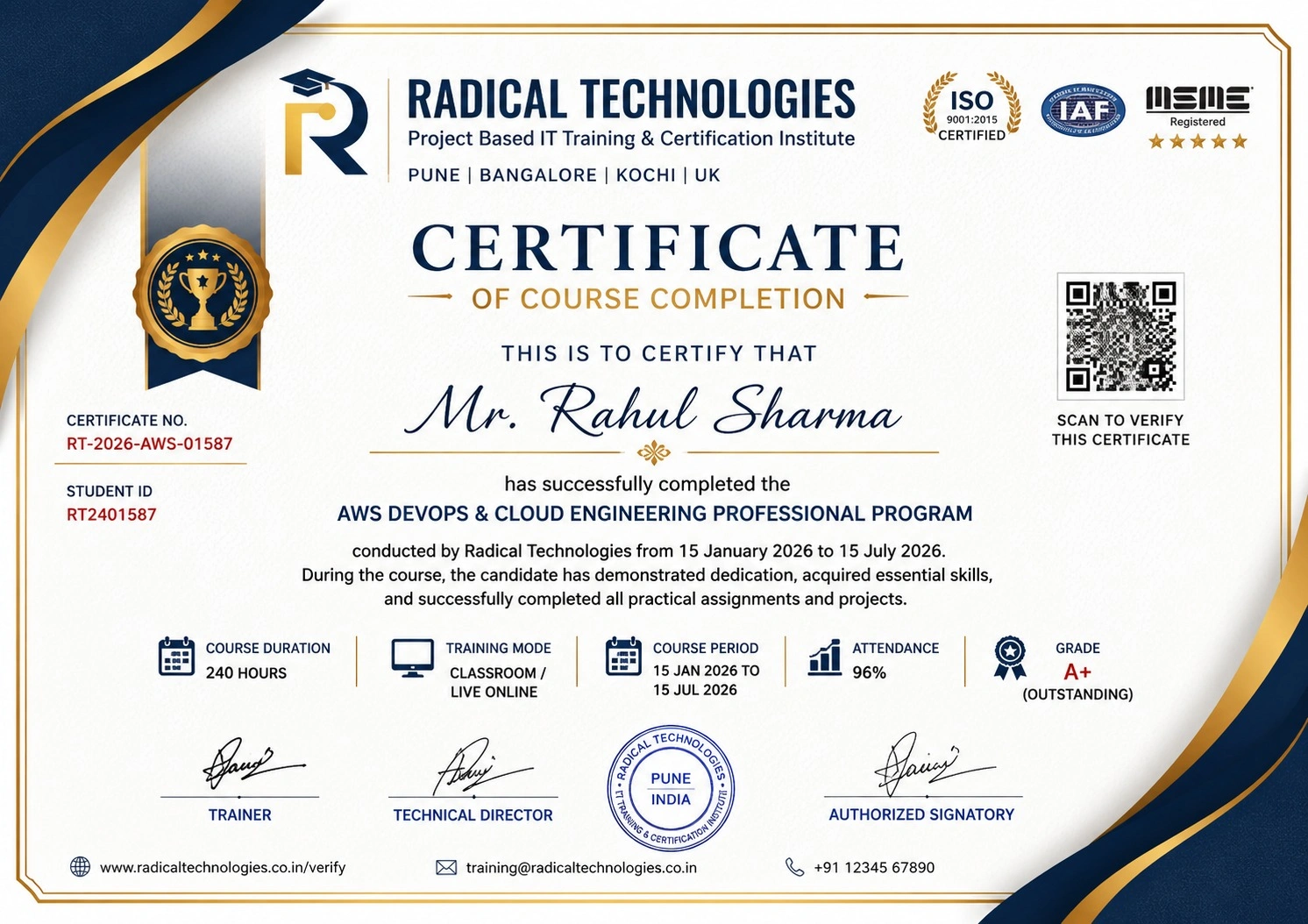
Certificate of Completion

Career Services

At Radical Technologies, we are committed to your success beyond the classroom. Our 100% Job Assistance program ensures that you are not only equipped with industry-relevant skills but also guided through the job placement process. With personalised resume building, interview preparation, and access to our extensive network of hiring partners, we help you take the next step confidently into your IT career.

Career Support

Course Completed? Need next steps?
Need Interview Supports?
Need Job Assistance?
Came from any other Institute?

Join our Brush-up Session & get support until you find a job!

Get Started

Radical Learning Eco-System

Exam Simulator

Cloud SandBox

Hands-on Cloud Lab

Developer Coding Ground

Student Reviews

4.4★
Average learner rating
50K+
Students trained
30+
Hiring companies alumni work at
100%
Placement assistance
4.4
★★★★★

Course Rating

★★★★★
62%
★★★★☆
21%
★★★☆☆
10%
★★☆☆☆
4%
★☆☆☆☆
3%

Our Alumni Work At

Accenture
Amazon
Avisys Services
Birlasoft
Capgemini
Catchpoint
Cognizant
Darwish Cybertech
DataVision
GiBots
Google
Groots Software
HCL Technologies
IBM
Info Gain
Infosys
ITCube Solutions
KPIT
L&T Infotech
Microsoft
Mphasis
mPhatek
Oracle
Quantbit Technologies
Saina Cloud
TCS
Tech Mahindra
Wipro
YASH Technologies
Zensar Technologies
Accenture
Amazon
Avisys Services
Birlasoft
Capgemini
Catchpoint
Cognizant
Darwish Cybertech
DataVision
GiBots
Google
Groots Software
HCL Technologies
IBM
Info Gain
Infosys
ITCube Solutions
KPIT
L&T Infotech
Microsoft
Mphasis
mPhatek
Oracle
Quantbit Technologies
Saina Cloud
TCS
Tech Mahindra
Wipro
YASH Technologies
Zensar Technologies